Learn Hiragana, Katakana and Kanji (N5–N4): Charts, Memory Tricks and Games
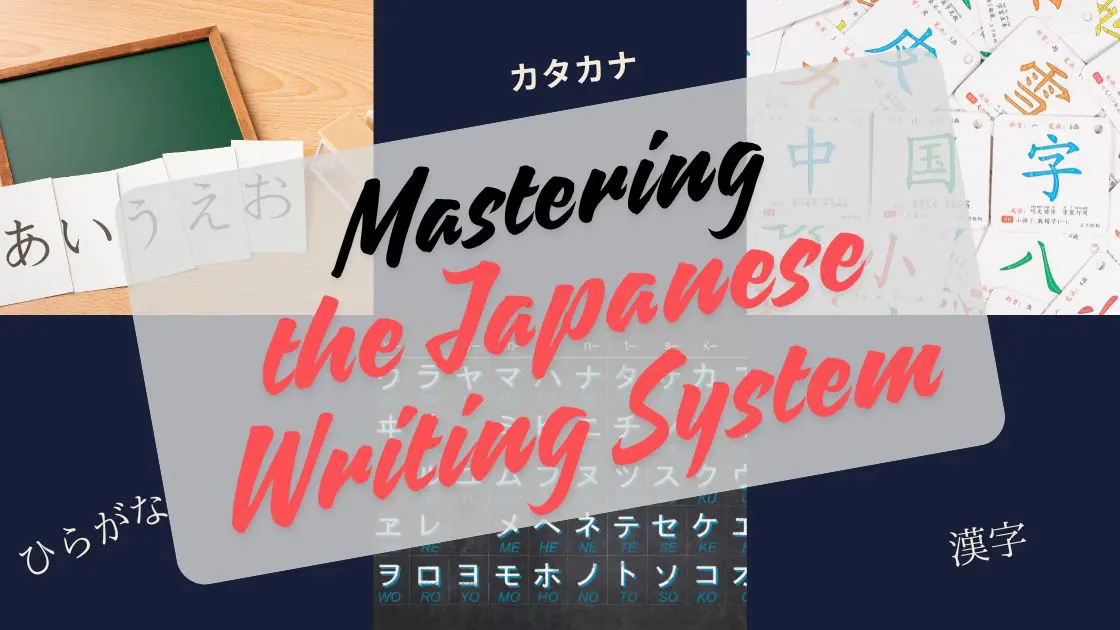
Japanese is written with three scripts: hiragana, katakana and kanji. That sounds scary, but here is the good news: you only need 46 hiragana and 46 katakana to read everything a Japanese child can read, and about 275 kanji to pass the JLPT N4. That is roughly the kanji in GENKI I and II.
This page is not just an explanation. It is a complete study tool. Every chart is interactive: tap a character to hear it, see a memory trick and watch the stroke order. Then play the games to lock everything into your memory. Your progress is saved in your browser, so you can come back every day.
Contents
Three scripts in one sentence
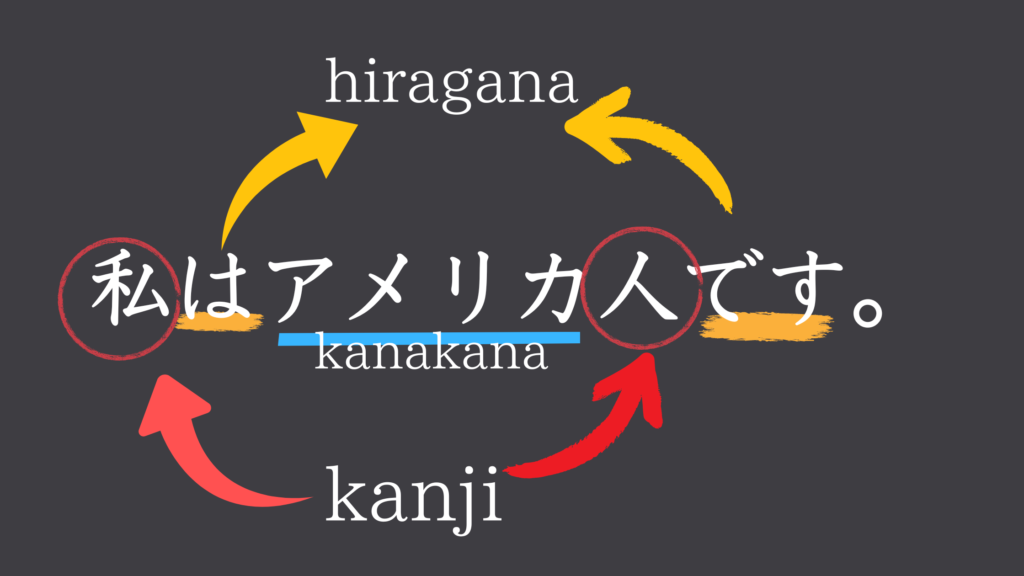
Japanese sentences mix all three scripts. Tap the buttons to see which part is which.
私はアメリカ人です。コーヒーが好きです。
Watashi wa Amerika-jin desu. Kōhī ga suki desu. — I’m American. I like coffee.
Your study plan
Step 1: Hiragana (ひらがな)
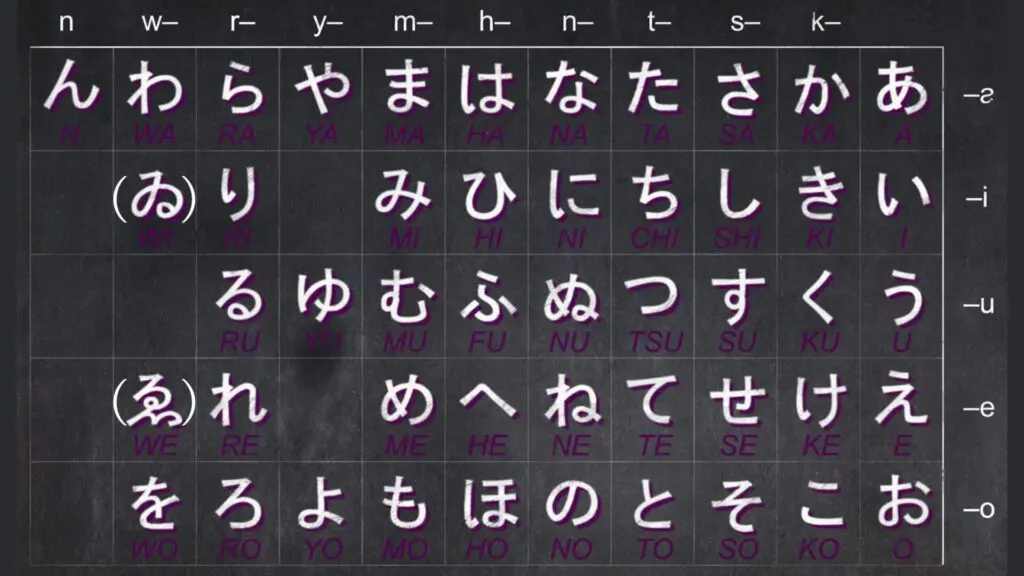
Hiragana is the base of written Japanese. Every word can be written in hiragana, and it is used for grammar: particles like は and を, verb endings like 〜ます, and many everyday words. Each character is one sound, so once you know the chart, you can read any hiragana word out loud.
The chart is easy to learn because it is built like a grid: five vowels (a, i, u, e, o) and a consonant for each row (k, s, t, n…). Learn it row by row, from top to bottom.
- Use the memory trick. A silly picture sticks better than a shape. You will see a trick for every character when you tap it.
- Say it out loud. Tap 🔊 and repeat. Your mouth helps your memory.
- Write it by hand. Watch the stroke order, then write each character 5 times. Writing makes the shape stay in your head.
- Test yourself early. Turn on “Hide romaji” and try to read the chart. Then play the Sprint.
Hiragana that look alike
These pairs confuse almost every learner. Look at the difference once, and you will never mix them up again.
They face opposite ways. さ opens to the left side like a smile; ち bulges to the right like the number 5.
ぬ has a little loop at the end (a noodle knot). め has no loop.
ね ends in a loop (a cat’s tail). れ ends with a kick out to the right.
わ ends in a round curve. れ ends with a kick.
る has a loop at the bottom. ろ is an open road.
ほ has an extra line on top (Santa’s hat).
In り the right stroke is much longer.
に has a stick on the left.
お has a separate dot at the top right. あ has a cross.
Changing the sound: か → が, は → ぱ
Two small marks change the sound. Two small dots ゛ (dakuten) makes the sound “heavier”: か ka → が ga, さ sa → ざ za, た ta → だ da, は ha → ば ba. A small circle ゜ (handakuten) turns the h-row into p: は ha → ぱ pa. Look at the “が・ぱ” tab in the chart above.
Small ゃ, ゅ, ょ and small っ
- Small ゃ ゅ ょ join with the character before: き + ゃ = きゃ (kya), one sound. Compare びよういん (beauty salon) and びょういん (hospital)!
- Small っ is a short pause before the next sound: きって (kitte, stamp). It doubles the next consonant in romaji.
- Long vowels are written with an extra vowel: おかあさん (okāsan), おとうさん (otōsan). In katakana, you use ー instead.
- Three particles are read differently: は is “wa”, へ is “e”, and を is “o” when they are particles. Example: わたしは (watashi wa).
Step 2: Katakana (カタカナ)
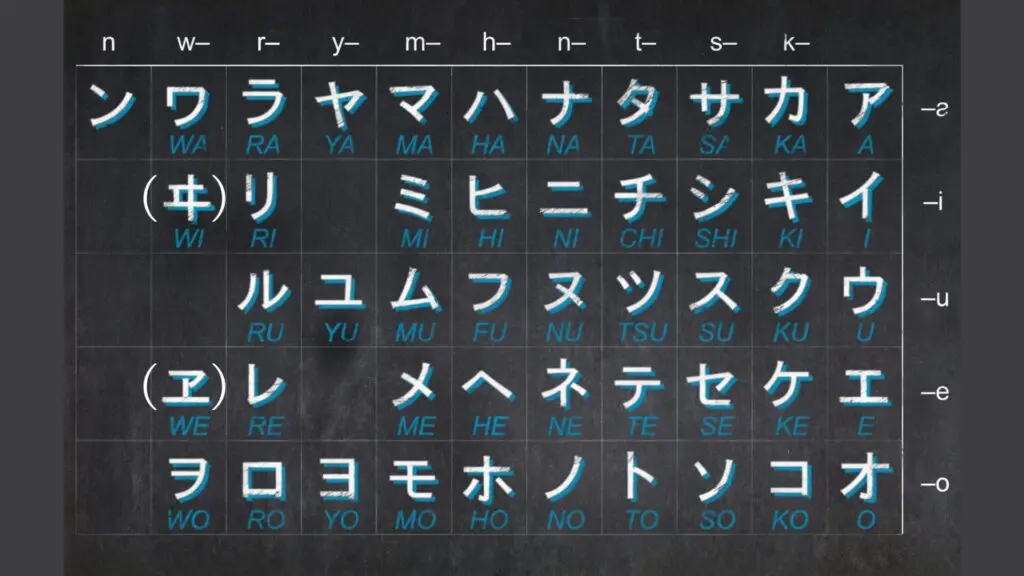
Katakana has the same 46 sounds as hiragana, but the shapes are sharper and more angular. You will see it everywhere in Japan: on menus, train stations, shop signs and in foreign names. Learning katakana means you can suddenly read hundreds of words you already know from English, like コーヒー (coffee) and タクシー (taxi).
Many katakana come from the same kanji as their hiragana partner, so they look similar: か/カ, き/キ, せ/セ, や/ヤ, へ/ヘ and り/リ. Start with these easy ones.
Katakana that look alike
Katakana has its own famous troublemakers. シ and ツ, and ソ and ン, are the hardest. The secret is the direction of the strokes.
シ (shi): the dots are on the left and the last stroke goes UP. ツ (tsu): the dots are on top and the last stroke comes DOWN.
ソ (so): both strokes come down from the top. ン (n): the dot is on the left and the long stroke goes UP.
タ (ta) has one extra short line inside.
ケ (ke) has a horizontal line that crosses through.
ウ (u) has an extra dot on top.
ヌ (nu) has an extra short line crossing the tail.
テ (te) has two flat lines on top; チ has a slanted one.
In ユ (yu) the bottom line sticks out to the right.
メ (me) is ノ with a second stroke crossing it.
How English words become katakana
Japanese words end in a vowel or ん, so foreign words change a little. If you know these 5 rules, you can guess many katakana words.
| Rule | Example |
|---|---|
| ー makes a long vowel | コーヒー (kōhī) coffee, ケーキ (kēki) cake |
| A vowel is added after consonants | ミルク (miruku) milk, ベッド (beddo) bed |
| Small ッ is a short pause | チケット (chiketto) ticket, ベッド (beddo) bed |
| L and R both become the ラ row | ホテル (hoteru) hotel, レストラン (resutoran) restaurant |
| New combinations for new sounds | パーティー (pātī) party, ファイル (fairu) file |
Japan also loves to shorten long words: スマホ (smartphone), パソコン (personal computer), コンビニ (convenience store).
Going to Japan soon? Katakana is the script you will need most on menus and signs. The Travel Japanese Pack has the phrases and words for restaurants, stations and shops, with audio.
Step 3: Kanji (漢字), N5 and N4
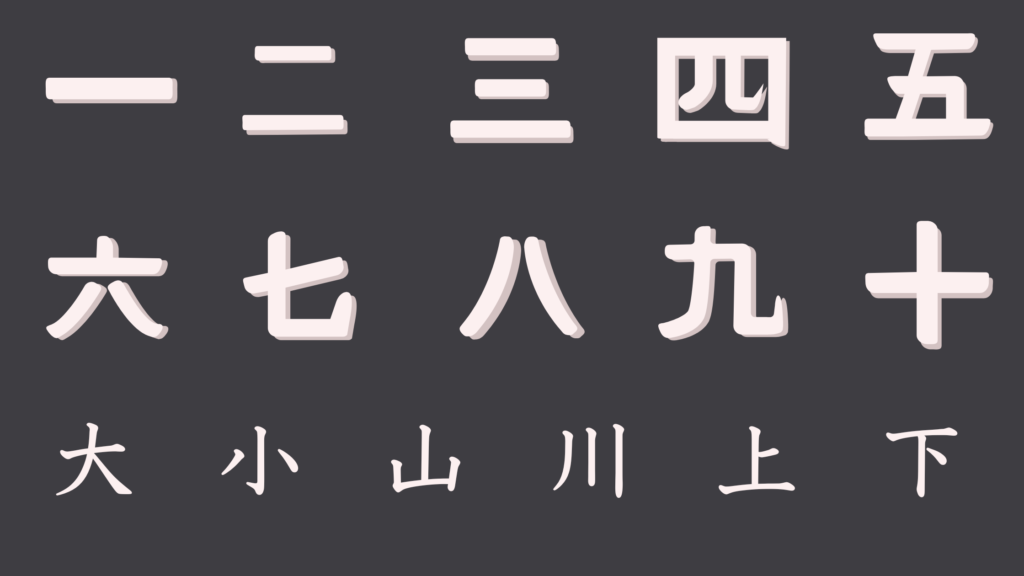
Kanji came from China. Each kanji has a meaning, and usually more than one reading. Japanese uses about 2,000 kanji in daily life, but you don’t need them all at once. For the JLPT N5 you need about 100, and for N4 about 175 more. This page has all 275 kanji for N5 and N4.
Kanji are pictures and building blocks
Many simple kanji started as pictures: 山 (mountain) has three peaks, 川 (river) is flowing water, 木 (tree) has branches and roots, 日 (sun) and 口 (mouth) are just shapes. Harder kanji are usually made by combining simple parts. A person (亻) next to a tree (木) makes 休 (rest). Once you know the parts, a “difficult” kanji becomes a small story.
15 parts that unlock hundreds of kanji
These parts (called radicals) show up again and again. They often give a hint about the meaning: kanji with 氵 are often about water, and kanji with 言 are about words.
On reading and kun reading
Most kanji have two kinds of readings. Don’t try to memorize every reading. Learn kanji inside real words, and the right reading will come naturally.
| When it is used | Example with 水 (water) | |
|---|---|---|
| Kun reading (Japanese) | The kanji stands alone, or has hiragana after it | 水 (みず, mizu) water |
| On reading (Chinese) | The kanji is in a word with other kanji | 水曜日 (すいようび, suiyōbi) Wednesday |
Kanji Explorer: all N5 and N4 kanji
Search by meaning, reading or romaji, or filter by level and theme. Tap a kanji for its readings, an example word, a memory trick and the stroke order animation.
- 5 new kanji a day is enough. In 8 weeks, you will know all of N5 and N4.
- Learn the word, not just the kanji. 電車 (train) is easier to remember than 電 alone.
- Make a story from the parts, like 休 = a person resting against a tree.
- Review before you learn new ones. Play one round of the Kanji Trainer first, then add new kanji.
- Read real Japanese. Find your kanji on menus, signs and in the grammar lessons on this site.
How to write: 5 stroke order rules
Stroke order matters. It makes your handwriting look natural, it helps you remember the shape, and it helps you look up kanji in apps. Almost every character follows these rules:
| Rule | Example |
|---|---|
| 1. From top to bottom | 三: top line first |
| 2. From left to right | 川: left stroke first |
| 3. Horizontal before vertical when they cross | 十: ー then | |
| 4. The middle before the sides (when the sides are small) | 小: the middle line first |
| 5. Outside box first, then the inside, then close it | 国: frame, inside, then the bottom line |
Handwriting vs. typed text: why some characters look different
Many learners get confused when a character in their textbook looks different from the same character on their phone. Don’t worry: it is the same character. Japanese has several common styles of lettering, just like English has handwriting, Times New Roman and Arial.
- Textbook style (教科書体, kyōkashotai) looks like careful handwriting. It shows every stroke clearly, so this is the style to copy when you write. All the charts and games on this page use it.
- Gothic (ゴシック体) is the style on most phones, apps and websites. It is clean and easy to read on a screen, but it often joins or simplifies strokes.
- Mincho (明朝体) is the style in books and newspapers, with thick and thin lines, like Times New Roman.
The last stroke is separate when you write it. Many fonts join it to the stroke above.
Same as き: written in 3 strokes, with a gap at the bottom. Fonts often join the last two.
Written as two separate strokes. In many fonts they are joined into one line.
Written in 4 separate strokes. Some fonts make it look like one connected shape.
Two shapes are correct: one stroke (common in handwriting) or a short line on top plus a zigzag (common in fonts).
The first stroke is a short line in handwriting. In Mincho fonts (books) it looks like a dot.
The bottom looks very different in fonts. Both shapes are correct, but write it like the textbook style.
The three dots look a little different in each style. All of them are correct.
- When you write, copy the textbook style and the stroke order animations, not the font on your screen.
- When you read, you need to recognize all three styles. Read a little on your phone and in books, and your eyes will get used to them quickly.
- Small differences like a joined stroke or the shape of a dot don’t change the meaning. In Japan, both shapes are usually accepted.
Typing Japanese: you type romaji, not shapes
On a computer or phone, you don’t need to know how to draw a character to type it. Turn on the Japanese keyboard and type the sounds in romaji: ka becomes か, and nihongo becomes にほんご. Press the space bar to change it into kanji (日本語) and choose the right one from the list. A few useful keys:
| To type | Press | Example |
|---|---|---|
| ん | nn | ほん → honn |
| small っ | double the next consonant | きって → kitte |
| ー (long vowel in katakana) | the minus key (-) | コーヒー → ko-hi- |
| small ぁ ぃ ゃ ゅ ょ | x or l before the vowel | ぁ → xa / la |
| katakana | F7 on a PC, or choose it in the list | たくしー → タクシー |
This is also why reading is more important than writing for most learners today: you will type far more Japanese than you write by hand. Still, writing by hand is the best way to remember characters, so practice both.
Final challenge
Ready to test everything? This mix of hiragana, katakana and kanji is different every time. Come back every day and try to get a perfect score.
FAQ
How long does it take to learn hiragana and katakana?
Most learners can read hiragana in 1–2 weeks with 20–30 minutes a day, and katakana in another 1–2 weeks. Reading quickly takes a little longer, so keep playing the Sprint games.
Should I learn romaji first?
No. Romaji is useful for the first few days, but start reading hiragana as soon as possible. Textbooks like GENKI switch to hiragana from Lesson 1, so it is best to be ready.
Do I really need kanji?
Yes, if you want to read Japanese. Kanji make reading easier because they show where words begin and what they mean. Without kanji, a long sentence in hiragana is very hard to read.
How many kanji do I need for the JLPT N5 and N4?
There is no official list, but N5 uses about 100 kanji, and N4 about 250–300 in total. This page covers the most common 275, which also match most of the kanji in GENKI I and II.
What’s next
- Step 1 of the grammar series: XはYです. Start reading real sentences.
- How to learn kanji: more strategies for kanji.
- Best apps and websites for learning Japanese.
Practice reading with a real teacher
Reading aloud with a teacher is one of the fastest ways to get confident with kana and kanji. On italki, you can find Japanese teachers for every level and book a short trial lesson.
This is an affiliate link. If you book a lesson, I may earn a small commission at no extra cost to you.
Stroke order animations use data from KanjiVG by Ulrich Apel, licensed under CC BY-SA 3.0. Sound uses your device’s Japanese voice.