Japanese Sentence Basics: XはYです, か, の and Telling Time (GENKI Lesson 1)
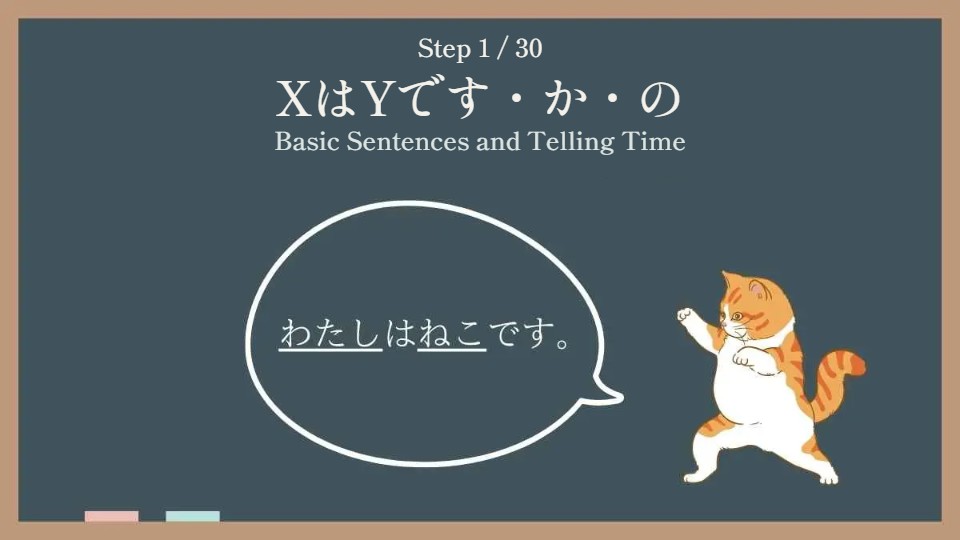
GENKI Lesson 1 is where your Japanese starts. In this lesson, you will learn how to say who you are, ask simple questions, connect two nouns, read phone numbers, and tell the time. Each section ends with a short quiz, so you can check your understanding right away.
- XはYです to say “X is Y”
- か to ask yes/no questions
- の to connect two nouns
- Phone numbers and telling the time
Contents
Start with the vocabulary
Let’s learn the GENKI Lesson 1 words first. Watch the video, then practice with the flashcards below. You will see these words again in every section of this lesson.
XはYです: “X is Y”
The first sentence pattern in Japanese is X は Y です. It means “X is Y.” X is the topic, the thing you are talking about. Y is what you say about it. です makes the sentence polite, so you can use it with anyone.
- は is read “wa” here, not “ha.” When は marks the topic, it is always pronounced “wa.”
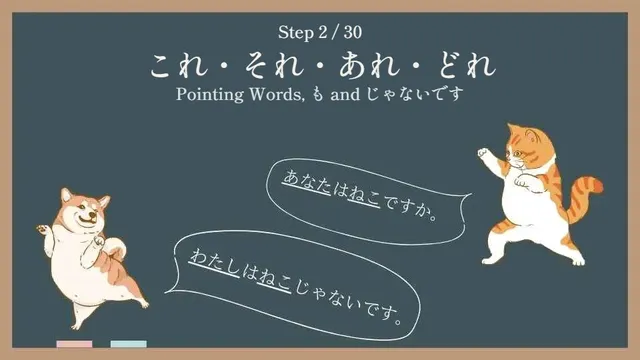
- You don’t need “I” every time. If it is clear you are talking about yourself, がくせいです。 is enough. In the same way, Japanese people rarely say あなた (“you”). Why anata can sound rude
- Use さん after other people’s names, never after your own. たけしさん is polite. メアリーさん for yourself sounds strange.
Questions with か
To make a yes/no question, add か at the end of the sentence. The word order does not change. Your voice usually goes up at the end, just like in English.
How to answer
| Answer | Meaning |
|---|---|
| はい、そうです。hai, soo desu. | Yes, that’s right. |
| いいえ、ちがいます。iie, chigaimasu. | No, that’s not right. |
| はい、わたしは がくせいです。hai, watashi wa gakusei desu. | Yes, I am a student. (full answer) |
Want to say “I am not a student”? That form (じゃないです) comes in GENKI Lesson 2.
The particle の: connecting two nouns
の connects two nouns. The first noun describes the second one. The second noun is the main thing. The order is the same as English “Mary’s book”: owner first, thing second.
| Use | Example | Meaning |
|---|---|---|
| Owner | メアリーさんの ほんMearii-san no hon | Mary’s book |
| Owner | わたしの でんわばんごうwatashi no denwa bangoo | my phone number |
| Group or school | さくらだいがくの がくせいSakura daigaku no gakusei | a student at Sakura University |
| Place | にほんの だいがくnihon no daigaku | a university in Japan |
| Kind or subject | にほんごの せんせいnihongo no sensei | a Japanese-language teacher |
にほんごの せんせい is a teacher who teaches Japanese. にほんじんの せんせい is a teacher who is Japanese. They can teach anything, even English.
Phone numbers
Read a phone number one digit at a time. Where English has a dash or a pause, Japanese uses の. Some numbers have two readings. For phone numbers, people usually use the first one.
Telling the time
For hours, say the number + じ. To ask the time, say いま なんじですか。 (What time is it now?) Most hours are regular, but three are different. Watch the red ones.
For minutes, add ふん or ぷん. The sound changes with some numbers. For 11 and up, put the parts together: 15 is じゅうごふん, 20 is にじゅっぷん.
Final check: 10 questions
Ready? These questions mix everything from Lesson 1. Get 8 or more right, and you are ready for Lesson 2.
Free worksheet
Want to practice writing? Download the printable worksheet for GENKI Lesson 1.
What’s next
- GENKI Lesson 2: これ・それ・あれ and saying “It’s not…”
- は vs が: why GENKI uses both from Lesson 1
- Free GENKI video course on YouTube: watch this lesson explained step by step
Practice speaking with a real teacher
Quizzes help you understand. Speaking helps you remember. Try saying your self-introduction to a Japanese teacher: わたしは〇〇です。せんこうは〇〇です。 On italki, you can find teachers who use GENKI and book a short trial lesson.
This is an affiliate link. If you book a lesson, I may earn a small commission at no extra cost to you.