Japanese Transitive vs Intransitive Verbs: 開く vs 開ける (GENKI Lesson 18)
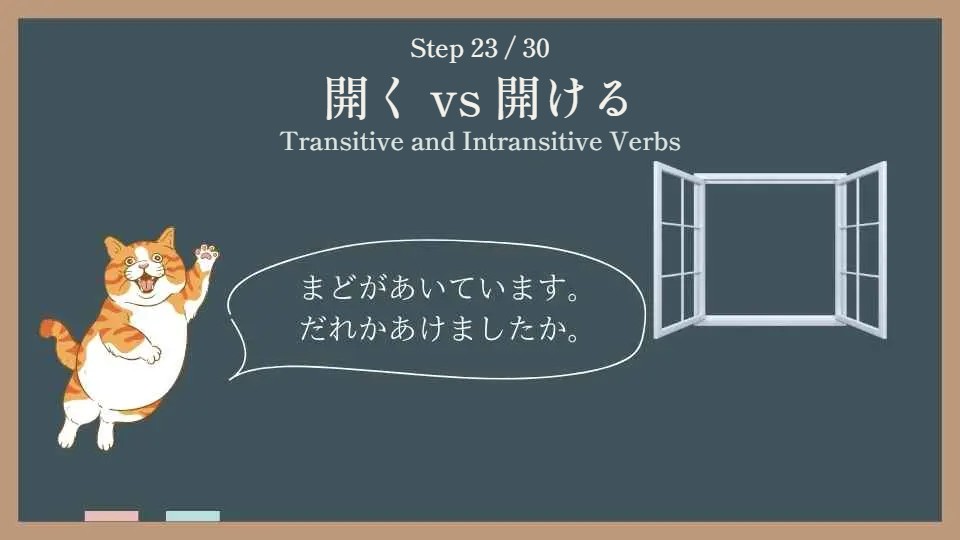
Many Japanese verbs come in pairs: 開く (to open, by itself) and 開ける (to open something). The first is intransitive (自動詞), the second is transitive (他動詞). Choosing the right one is a big step toward natural Japanese. You learn these pairs in GENKI Lesson 18.
- Intransitive (が) vs transitive (を)
- Common verb pairs to learn first
- Sound patterns that help you remember
- Describing a state with intransitive verb + ている
Contents
Intransitive vs transitive
| Intransitive (自動詞) | Transitive (他動詞) | |
|---|---|---|
| Meaning | Something happens (by itself) | Someone does something to something |
| Particle | Thing + が | Person が/は + thing + を |
| Example | ドアが開きます。ドアが あきます。 (The door opens.) | 私がドアを開けます。わたしが ドアを あけます。 (I open the door.) |
Can you put を before the verb? Then it is transitive. ✓ 電気を消す. ✗ 電気を消える.
Common pairs to learn first
| Intransitive (が) | Transitive (を) | Meaning |
|---|---|---|
| 開くあく | 開けるあける | open |
| 閉まるしまる | 閉めるしめる | close |
| 始まるはじまる | 始めるはじめる | begin |
| 終わるおわる | 終えるおえる | end |
| 付くつく | 付けるつける | turn on |
| 消えるきえる | 消すけす | turn off |
| 入るはいる | 入れるいれる | enter / put in |
| 出るでる | 出すだす | go out / take out |
| 壊れるこわれる | 壊すこわす | break |
| 落ちるおちる | 落とすおとす | fall / drop |
| 汚れるよごれる | 汚すよごす | get dirty / make dirty |
| 起きるおきる | 起こすおこす | wake up / wake someone up |
Patterns that help
There is no single rule for all verbs, but these sound patterns cover many pairs.
| Intransitive | Transitive | Examples |
|---|---|---|
| -aru | -eru | 始まる/始める、集まる/集める、変わる/変えるはじまる/はじめる、あつまる/あつめる、かわる/かえる |
| -reru | -su | 壊れる/壊す、汚れる/汚すこわれる/こわす、よごれる/よごす |
| -eru | -asu | 出る/出す、燃える/燃やすでる/だす、もえる/もやす |
| -iru | -osu | 起きる/起こす、落ちる/落とすおきる/おこす、おちる/おとす |
Some pairs go the other way. 開く (intransitive) / 開ける (transitive), 付く / 付ける. Learn each pair with an example sentence.
Intransitive + ている: a state
Use an intransitive verb + ている to describe the state something is in now.
Compare: 窓を開けている means someone is opening the window (an action in progress).
Final check: 8 questions
Choose the right verb for each sentence. Get 7 or more right, and you have a good feel for verb pairs!
What’s next
- Sonkeigo: honorific verbs like いらっしゃる
- The passive: 〜られる
- More Everyday Expressions: 〜てしまう
Practice speaking with a real teacher
Verb pairs are easiest to learn by describing what you see. On a video call, ask a teacher to do small actions (open a book, turn off a light) while you describe them. On italki, you can find teachers who use GENKI and book a short trial lesson.
This is an affiliate link. If you book a lesson, I may earn a small commission at no extra cost to you.