Japanese Passive Form 〜られる and the Suffering Passive (GENKI Lesson 21)
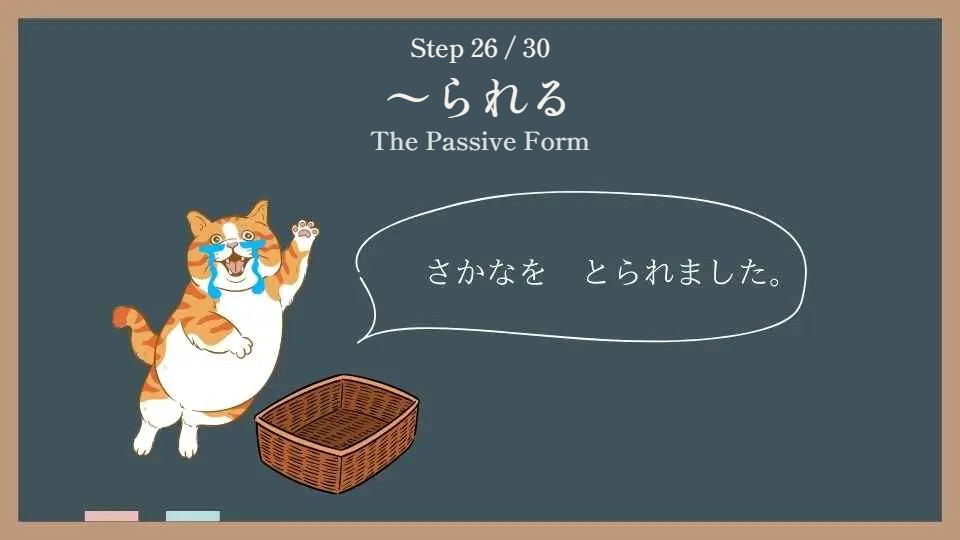
The passive form describes something from the point of view of the person or thing that receives an action: “I was praised,” “My wallet was stolen.” Japanese also has a special use that English doesn’t: the suffering passive, for when something happens that bothers you. You learn the passive in GENKI Lesson 21.
- How to make the passive form
- Who did it: に, から and によって
- The suffering (adversity) passive: 雨に降られた
- Passive with an object: 足を踏まれた
Contents
How to make the passive
| Verb group | Rule | Example |
|---|---|---|
| う-verbs | last sound → あ sound + れる | 読む → 読まれる、言う → 言われるよまれる、いわれる |
| る-verbs | drop る + られる | 食べる → 食べられるたべられる |
| する | する → されるされる | |
| 来る | 来る → 来られるこられる |
Passive verbs are all る-verbs: 読まれます, 読まれない, 読まれた.
For る-verbs, the passive and the potential look the same: 食べられる can mean “can eat” or “be eaten.” The context tells you which. For う-verbs, they are different: 読める (can read) vs 読まれる (be read).
Basic passive: に marks who did it
When the doer is not important
から and によって
| Particle | When | Example |
|---|---|---|
| に | The usual way to mark the doer | 先生にほめられたせんせいに ほめられた |
| から | When something is passed from a person: words, gifts, information | 母から何度も注意されたははから なんども ちゅういされた (I was warned many times by my mother.) |
| によって | Formal; creators, inventors, and causes. Common in writing and the news. | この絵はピカソによって描かれたこの えは ピカソに よって えがかれた (This painting was painted by Picasso.) |
The suffering passive
Japanese often uses the passive to say that something bad happened to you because of someone else. It can even be used with verbs that have no object in English, like “rain” or “cry.”
Passive + を: something of yours
When someone does something to your thing or body part, the thing keeps を, and you are the subject.
✗ 私の財布は盗まれました is understandable, but Japanese people usually say 私は財布を盗まれました. The person who suffers is the subject.
Final check: 10 questions
Get 8 or more right, and you are ready for the causative.
What’s next
Practice speaking with a real teacher
The suffering passive is perfect for telling funny stories about bad days. Try one with a teacher: 昨日、雨に降られて、犬に靴をかまれました! On italki, you can find teachers who use GENKI and book a short trial lesson.
This is an affiliate link. If you book a lesson, I may earn a small commission at no extra cost to you.