Japanese Causative-Passive 〜させられる: Be Made to Do (GENKI Lesson 23)
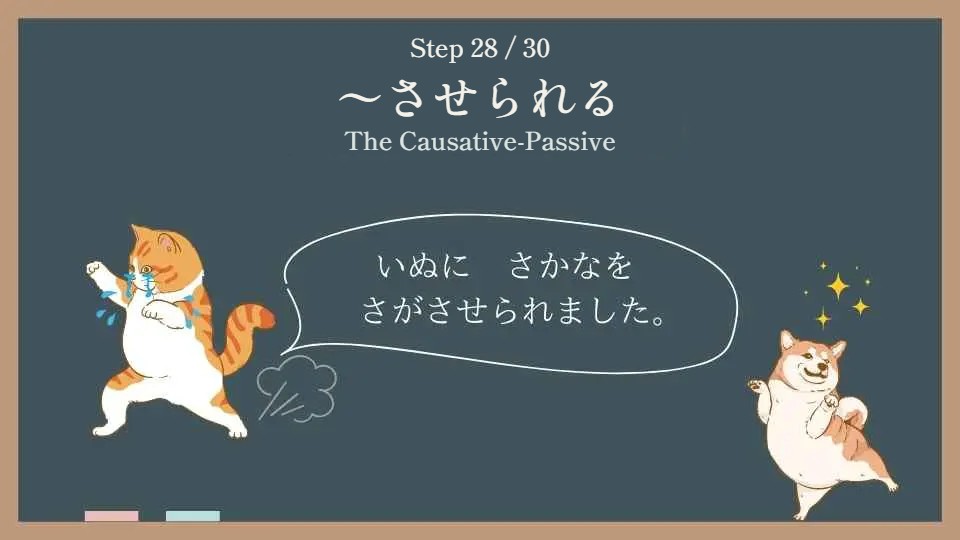
The causative-passive (使役受身) means “to be made to do something,” usually something you didn’t want to do. It combines the causative (make someone do) and the passive (be done to). You learn it in GENKI Lesson 23.
- How to make 〜させられる (and the short form 〜される)
- Causative vs causative-passive
- Marking who made you do it with に
- The emotional use: 考えさせられる
Contents
How to make the causative-passive
Start from the causative (〜せる / 〜させる). It is a る-verb, so drop る and add the passive られる.
| Verb | Causative | Causative-passive | Short form (spoken) |
|---|---|---|---|
| 書くかく | 書かせるかかせる | 書かせられるかかせられる | 書かされるかかされる |
| 飲むのむ | 飲ませるのませる | 飲ませられるのませられる | 飲まされるのまされる |
| 話すはなす | 話させるはなさせる | 話させられるはなさせられる | (none) |
| 食べるたべる | 食べさせるたべさせる | 食べさせられるたべさせられる | (none) |
| する | させる | させられる | (none) |
| 来るくる | 来させるこさせる | 来させられるこさせられる | (none) |
For う-verbs, people usually shorten 〜せられる to 〜される: 書かされる, 飲まされる, 待たされる. Verbs ending in す (話す) and all る-verbs and irregular verbs don’t have the short form.
Using it: “I was made to …”
The feeling is almost always negative: you didn’t want to do it.
Causative vs causative-passive
They describe the same event from two sides.
| Form | Point of view | Example |
|---|---|---|
| Causative | The person who makes | 母は私に部屋を掃除させました。ははは わたしに へやを そうじ させました。 (My mother made me clean my room.) |
| Causative-passive | The person who is made | 私は母に部屋を掃除させられました。わたしは ははに へやを そうじ させられました。 (I was made to clean my room by my mother.) |
In the causative-passive, the person who does the action (usually you) is the subject. The person who made you do it takes に.
An emotional use: 考えさせられる
With verbs of feeling and thinking, the causative-passive can mean something (a movie, a story) made you feel or think. This use is positive or neutral.
Final check: 8 questions
Get 7 or more right, and you have finished the hardest verb forms in GENKI!
What’s next
- Everyday Expressions: もう / まだ, つもり, 〜てみる and 〜ておく
- The causative: 〜させる
- The passive: 〜られる
Practice speaking with a real teacher
Complaining is great practice for the causative-passive! Tell a teacher about something you were made to do as a child: 子どものとき、毎朝早く起きさせられました。 On italki, you can find teachers who use GENKI and book a short trial lesson.
This is an affiliate link. If you book a lesson, I may earn a small commission at no extra cost to you.