Japanese Causative Form 〜させる: Make and Let (GENKI Lesson 22)
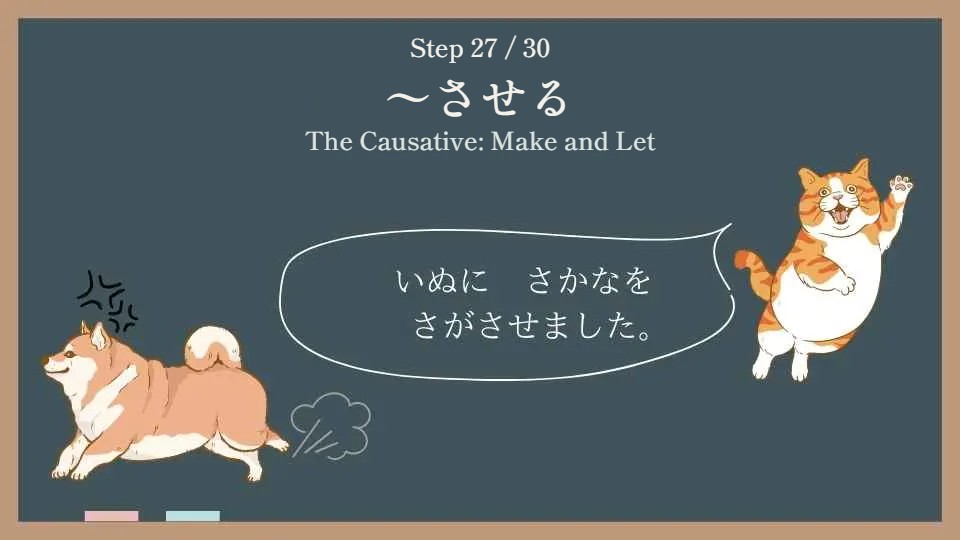
The causative form (使役形) means “make someone do” or “let someone do.” A parent makes a child eat vegetables. A boss lets you go home early. Combined with giving and receiving verbs, it also gives you one of the most useful polite phrases in Japanese: 〜させてください (please let me …). You learn it in GENKI Lesson 22.
- How to make the causative form
- “Make” vs “let”
- The particles を and に
- 〜させてください, 〜させてくれる, 〜させてもらう
Contents
How to make the causative
| Verb group | Rule | Example |
|---|---|---|
| う-verbs | last sound → あ sound + せる | 読む → 読ませる、買う → 買わせるよませる、かわせる |
| る-verbs | drop る + させる | 食べる → 食べさせるたべさせる |
| する | する → させるさせる | |
| 来る | 来る → 来させるこさせる |
Causative verbs are る-verbs: 読ませます, 読ませない, 読ませた, 読ませて.
Make or let?
The same form can mean make (force) or let (allow). The situation tells you which.
Particles: を or に?
| Verb type | Person who does the action | Example |
|---|---|---|
| Transitive (has an object with を) | に | 社長は部下に資料を作らせた。しゃちょうは ぶかに しりょうを つくらせた。 (The president had his staff make the documents.) |
| Intransitive (no object) | を or に | 先生は学生を立たせた。せんせいは がくせいを たたせた。 (The teacher made the student stand.) |
With intransitive verbs, を often sounds like forcing, and に sounds more like allowing: 子どもを帰らせた (I sent the child home) / 子どもに好きなだけ遊ばせた (I let the child play as much as they liked).
Causative + giving and receiving
Combine the causative te-form with the verbs from あげる, くれる and もらう.
| Pattern | Meaning | Example |
|---|---|---|
| 〜させてください | Please let me … | ここで写真を撮らせてください。ここで しゃしんを とらせて ください。 (Please let me take a photo here.) |
| 〜させてくれる | Someone lets me … | 母は留学させてくれました。ははは りゅうがく させて くれました。 (My mother let me study abroad.) |
| 〜させてもらう | I get permission to … | 部長に早く帰らせてもらいました。ぶちょうに はやく かえらせて もらいました。 (The manager let me go home early.) |
| 〜させてあげる | I let someone … | 弟にゲームをさせてあげました。おとうとに ゲームを させて あげました。 (I let my little brother play the game.) |
Polite requests at work
〜させていただけませんか is a very polite way to ask for permission. You hear it in business all the time.
考えさせてください (Let me think about it) is also a polite way to say “no” in Japan.
Final check: 10 questions
Get 8 or more right, and you are ready for the causative-passive.
What’s next
- The causative-passive: 〜させられる
- The passive: 〜られる
- あげる, くれる and もらう
Practice speaking with a real teacher
Talk about your childhood with a teacher: 子どものとき、母に毎日ピアノを練習させられました。でも、好きなことも自由にさせてくれました。 On italki, you can find teachers who use GENKI and book a short trial lesson.
This is an affiliate link. If you book a lesson, I may earn a small commission at no extra cost to you.