Japanese あげる, くれる, もらう: Giving and Receiving (GENKI Lessons 14, 16)
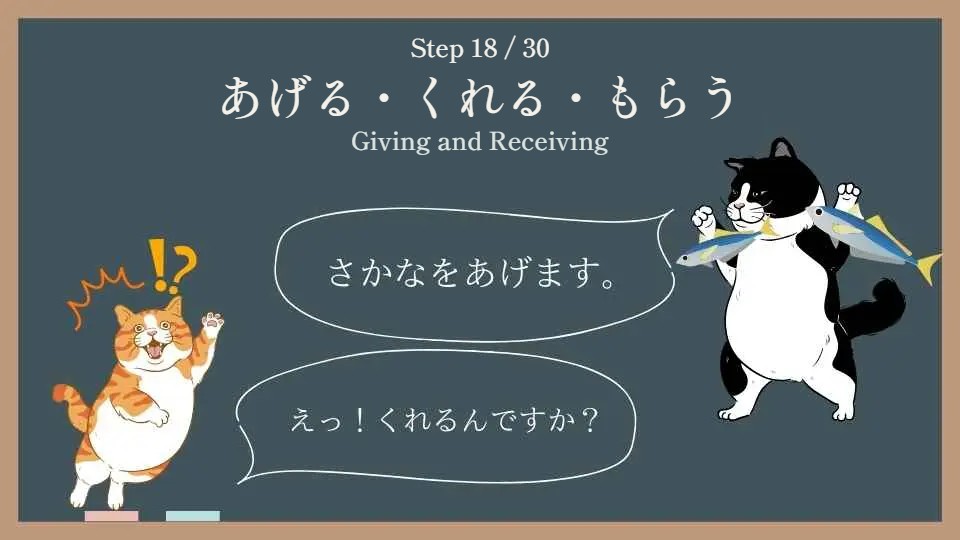
English has “give” and “receive.” Japanese has three verbs, and which one you use depends on direction: is the thing moving away from you, or toward you? Once you see the direction, the choice becomes easy.
You learn the verbs for things in GENKI Lesson 14, and the 〜て versions for actions in GENKI Lesson 16.
- あげる: give (away from me)
- くれる: give (to me or my group)
- もらう: receive
- 〜てあげる / 〜てくれる / 〜てもらう: doing things for someone
Contents
The key: who is on “my side”?
Think of a circle around you. Inside the circle are you and the people close to you, like your family. This is your in-group (うち). Everyone else is outside (そと).
| Verb | Direction | Pattern |
|---|---|---|
| あげるあげる | Me (or my side) → someone else, or one outsider → another | Giver は Receiver に Thing を あげる |
| くれるくれる | Someone → me (or my side) | Giver は 私に Thing を くれる |
| もらうもらう | I (or someone) receive from someone | Receiver は Giver に/から Thing を もらう |
If the thing comes to you, never use あげる. ✗ 友だちが私にプレゼントをあげました → ✓ 友だちが私にプレゼントをくれました.
あげる: giving away
くれる: giving to me
Use くれる when the receiver is you or someone on your side. It often carries a feeling of thanks.
私に is often left out, because くれる already shows the thing came to you.
もらう: receiving
With もらう, the receiver is the subject. The giver is marked with に or から.
Same event, two ways
Doing things for someone: 〜てあげる・〜てくれる・〜てもらう
Put the verbs after a te-form, and they show who does a favor for whom. The direction rules are exactly the same.
| Pattern | Meaning | Example |
|---|---|---|
| 〜てあげる〜てあげる | I do something for someone | 妹に宿題を教えてあげました。いもうとに しゅくだいを おしえて あげました。 (I taught my sister her homework.) |
| 〜てくれる〜てくれる | Someone does something for me | 母が料理を作ってくれました。ははが りょうりを つくって くれました。 (My mother cooked for me.) |
| 〜てもらう〜てもらう | I have someone do something for me | 友だちに手伝ってもらいました。ともだちに てつだって もらいました。 (I got my friend to help me.) |
Saying 〜てあげる directly to someone can sound like you are doing them a big favor. To offer help politely, say 手伝いましょうか (Shall I help?) instead of 手伝ってあげます.
To thank someone for what they did, use 〜てくれてありがとう. See 〜てくれてありがとう and 〜てすみません.
More polite versions
When the other person is above you (a teacher, a boss, a customer), use these polite verbs. You will learn them in GENKI Lessons 19 and 20.
| Plain | Polite | Example |
|---|---|---|
| あげる | さしあげる | 先生に花をさしあげました。せんせいに はなを さしあげました。 |
| くれる | くださる | 先生が本をくださいました。せんせいが ほんを くださいました。 |
| もらう | いただく | 先生に本をいただきました。せんせいに ほんを いただきました。 |
Final check: 10 questions
Choose あげる, くれる or もらう for each situation. Get 8 or more right, and you have mastered the direction rule!
What’s next
- 〜てくれてありがとう and 〜てすみません: thanks and apologies
- The causative: 〜させてあげる, 〜させてくれる, 〜させてもらう
- Sonkeigo: くださる and other honorific verbs
Practice speaking with a real teacher
Giving and receiving verbs feel natural only after you use them in real stories. Tell a teacher about the best present you ever got: 誕生日に、母が時計をくれました。 On italki, you can find teachers who use GENKI and book a short trial lesson.
This is an affiliate link. If you book a lesson, I may earn a small commission at no extra cost to you.