Japanese これ, それ, あれ, どれ Explained: も and じゃないです (GENKI Lesson 2)
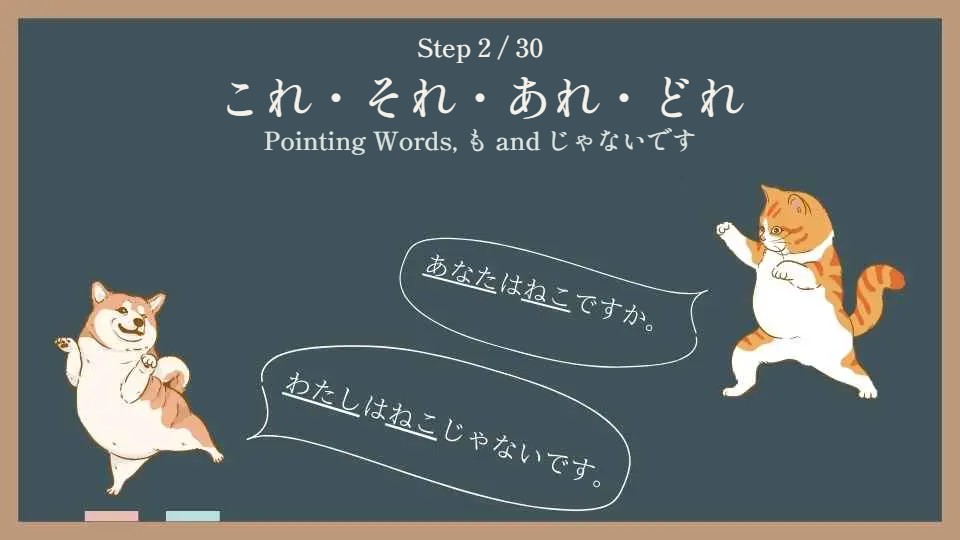
In GENKI Lesson 2, you learn how to point at things, ask “which one?”, and say that something is not what someone thinks. These are the words you need for shopping, asking for directions and talking about things around you.
- これ・それ・あれ・どれ to say “this one / that one / which one”
- この・その・あの・どの + noun to say “this book / that bag”
- ここ・そこ・あそこ・どこ to talk about places
- だれの (whose), も (too, also) and じゃないです (is not)
- ね and よ to sound natural
Contents
Start with the vocabulary
Let’s learn the GENKI Lesson 2 words first. Watch the video and repeat the words out loud. You will see many of them in the examples below.
これ・それ・あれ・どれ: this one, that one, which one
Japanese has a set of “pointing words.” The first sound tells you where the thing is: ko- near me, so- near you, a- far from both of us, and do- for questions. People call them the “ko-so-a-do” words.
| Word | Where is the thing? | Meaning |
|---|---|---|
| これkore | Near the speaker (me) | this one |
| それsore | Near the listener (you) | that one (near you) |
| あれare | Far from both of us | that one over there |
| どれdore | Question word | which one? |
この・その・あの・どの + noun
これ, それ, あれ and どれ stand alone. When you want to put a noun after them, change the ending to -no: この, その, あの, どの. They can never stand alone.
- これ・それ・あれ・どれ + は / が / を … (no noun after them)
- この・その・あの・どの + noun (always)
- ✗ これ ほん → ✓ この ほん (this book)
ここ・そこ・あそこ・どこ: here, there, over there, where
The same ko-so-a-do pattern works for places. This is very useful when you are looking for something in a shop or a station.
| Word | Meaning | Example |
|---|---|---|
| ここkoko | here (near me) | ここは レストランですか。koko wa resutoran desu ka. (Is this a restaurant?) |
| そこsoko | there (near you) | そこは ゆうびんきょくです。soko wa yuubinkyoku desu. (That is the post office.) |
| あそこasoko | over there | あそこです。asoko desu. (It’s over there.) |
| どこdoko | where? | トイレは どこですか。toire wa doko desu ka. (Where is the restroom?) |
Notice that “over there” is あそこ, not “あこ.” It is the only irregular word in this set.
だれの: whose?
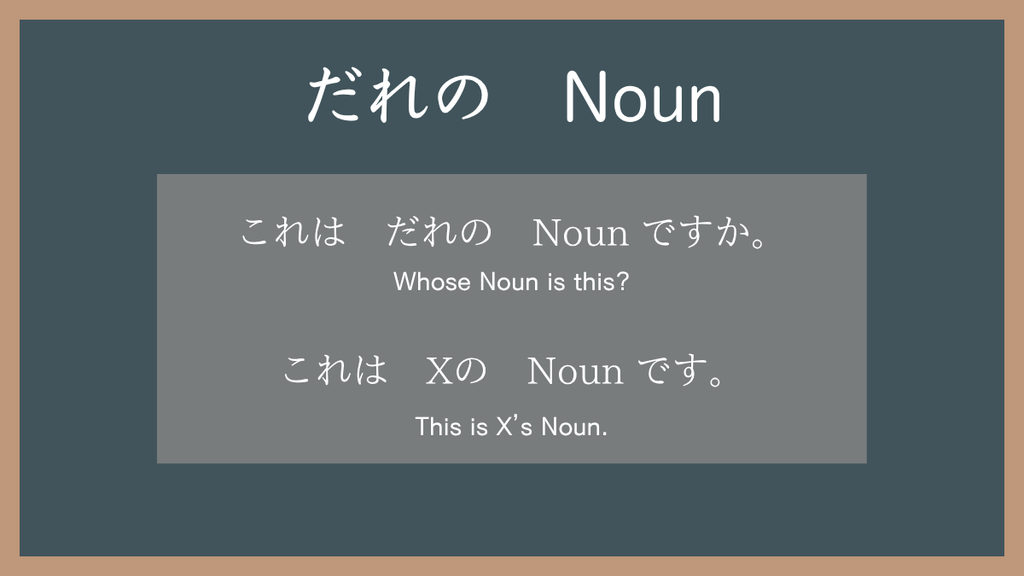
だれ means “who.” Add の and it means “whose.” You learned the の that connects nouns in Lesson 1.
In the answer, you can drop the thing: たけしさんの かさです → たけしさんのです (It’s Takeshi’s).
も: “too” and “also”
When the second thing is the same as the first, use も instead of は. It means “too” or “also.”
も replaces は. Don’t use both. ✗ サムさんはも → ✓ サムさんも
じゃないです: “is not”
In Lesson 1, you learned X は Y です (X is Y). To say “X is not Y,” change です to じゃないです.
| Form | Feeling |
|---|---|
| じゃないですja nai desu | Polite, common in conversation |
| じゃありませんja arimasen | Polite, a little more formal |
| ではありませんdewa arimasen | Formal, often in writing |
All three mean the same thing. GENKI uses じゃないです, and that is what you will hear most often.
Sounding natural: ね and よ
Japanese conversation is full of these two little words. Put one at the end of a sentence, and you will sound much less like a textbook.
| Ending | Feeling | Example |
|---|---|---|
| ねne | “…right?” You think the listener agrees. | この Tシャツ、いいですね。kono tiishatsu, ii desu ne. (This T-shirt is nice, isn’t it?) |
| よyo | “…you know.” You give new information. | それは かさじゃないですよ。sore wa kasa ja nai desu yo. (That’s not an umbrella, you know.) |
Want to know more little endings like ね and よ? See Japanese sentence-ending particles.
Try it: shopping in Japanese
Now put it all together. Here is a short conversation in a shop. Notice これ, それ, あの, いくら and じゃないです.
Going to Japan soon? My Travel Japanese Pack has more shopping phrases with audio.
Final check: 10 questions
These questions mix everything from Lesson 2. Get 8 or more right, and you are ready for Lesson 3.
Free worksheet
Want to practice writing? Download the printable worksheet for GENKI Lesson 2.
What’s next
- GENKI Lesson 3: verbs, particles and your daily routine
- GENKI Lesson 1: review XはYです and の
- Essential Japanese Phrases for Travel: use これ・それ・いくら in real shops
Practice speaking with a real teacher
Pointing words are easiest to learn in a real conversation. Try asking a teacher about things on their desk: それは なんですか。 これは いくらですか。 On italki, you can find teachers who use GENKI and book a short trial lesson.
This is an affiliate link. If you book a lesson, I may earn a small commission at no extra cost to you.