Japanese Sonkeigo: Honorific Verbs like いらっしゃる (GENKI Lesson 19)
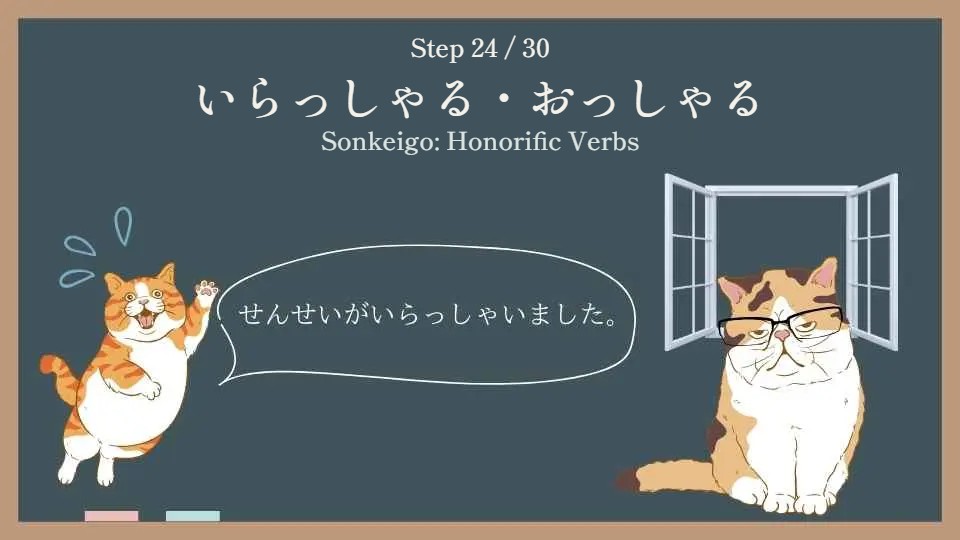
Sonkeigo (尊敬語) is respectful language. You use it to talk about the actions of people above you: teachers, bosses, customers, or someone you just met. It raises the other person. You learn it in GENKI Lesson 19.
Its partner, kenjōgo (humble language), lowers your own actions. See Kenjōgo after this lesson.
- Special honorific verbs: いらっしゃる, なさる, 召し上がる …
- The regular pattern: お + stem + になる
- Respectful requests: お〜ください and 〜てくださる
- When to use sonkeigo, and when not to
Contents
Special honorific verbs
The most common verbs have their own honorific form. Learn these first.
| Plain | Sonkeigo | Example |
|---|---|---|
| いる / 行く / 来る | いらっしゃるいらっしゃる | 先生は研究室にいらっしゃいますか。せんせいは けんきゅうしつに いらっしゃいますか。 (Is the professor in her office?) |
| する | なさるなさる | 週末は何をなさいますか。しゅうまつは なにを なさいますか。 (What will you do this weekend?) |
| 食べる / 飲む | 召し上がるめしあがる | どうぞ召し上がってください。どうぞ めしあがって ください。 (Please help yourself.) |
| 言う | おっしゃるおっしゃる | 先生がそうおっしゃいました。せんせいが そう おっしゃいました。 (The teacher said so.) |
| 見る | ご覧になるごらんになる | この写真をご覧になりましたか。この しゃしんを ごらんに なりましたか。 (Have you seen this photo?) |
| 寝る | お休みになるおやすみになる | 部長はもうお休みになりました。ぶちょうは もう おやすみに なりました。 (The manager has gone to bed.) |
| 知っている | ご存じだごぞんじだ | 田中先生をご存じですか。たなかせんせいを ごぞんじですか。 (Do you know Professor Tanaka?) |
| くれる | くださるくださる | 社長がアドバイスをくださいました。しゃちょうが アドバイスを くださいました。 (The president gave me advice.) |
いらっしゃる, なさる, おっしゃる and くださる have a special ます form: いらっしゃいます, なさいます, おっしゃいます, くださいます (not いらっしゃります).
The regular pattern: お + stem + になる
For most other verbs, take the ます stem and put it between お and になる.
For する-verbs from Chinese words, use ご: ご利用になる (use), ご説明になる (explain).
The passive form (〜れる / 〜られる) can also show respect: 先生が書かれた本 (a book the professor wrote). It is a lighter, common style in business and the news.
Respectful requests
お + stem + ください
This is a polite way to ask a customer or guest to do something. You see it on signs everywhere in Japan.
〜てくださる
When a superior does something for you, use 〜てくださる (the respectful 〜てくれる).
When to use sonkeigo
- Use it for the actions of other people who deserve respect: teachers, bosses, customers, older people you don’t know well.
- Never use it for your own actions. ✗ 私はいらっしゃいます → ✓ 私は参ります (humble).
- When you talk to someone outside your company, don’t use sonkeigo for your own boss: 部長の田中は今、外出しております.
- Don’t overdo it. Too many honorifics in one sentence can sound strange.
Shop staff use sonkeigo with you all the time: いらっしゃいませ (welcome) is the imperative of いらっしゃる! Listen for it on your trip with the Travel Japanese Pack.
Final check: 10 questions
Get 8 or more right, and you are ready for kenjōgo.
What’s next
- Kenjōgo: humble language for your own actions
- あげる, くれる and もらう: くださる and いただく
- Is “anata” rude?
Practice speaking with a real teacher
Keigo becomes natural only with practice in real situations. Ask a teacher to role-play a job interview or a hotel check-in with you. On italki, you can find teachers who specialize in business Japanese and book a short trial lesson.
This is an affiliate link. If you book a lesson, I may earn a small commission at no extra cost to you.