Japanese ます Form and Particles を, で, に, へ + ませんか (GENKI Lesson 3)
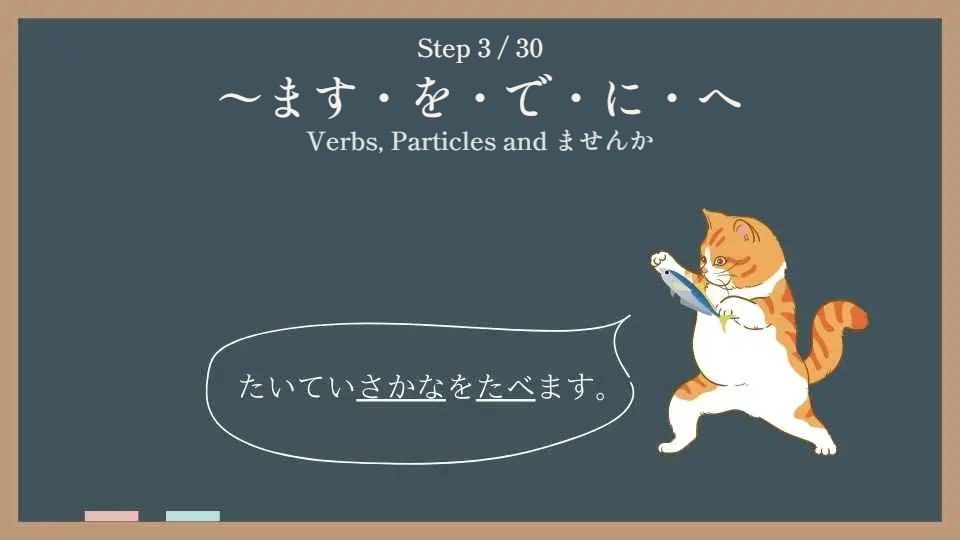
In GENKI Lesson 3, you finally start using verbs. With verbs and a few particles, you can talk about your daily life: what you eat, where you go and when you get up. You will also learn how to invite someone to do something together.
- The three verb groups and the polite ます form
- How to tell a る-verb from an う-verb
- The particles を・で・に・へ
- Time with に, and frequency words like いつも and ぜんぜん
- Inviting with 〜ませんか and suggesting with 〜ましょう
Contents
Start with the vocabulary
Lesson 3 has many new verbs. Watch the video and say each word out loud before you read the grammar.
The ます form: polite verbs
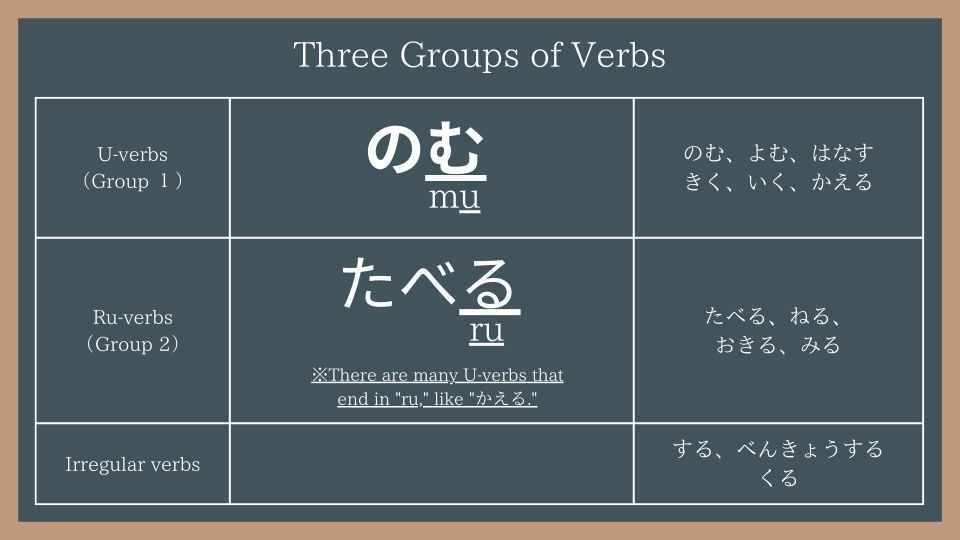
Every Japanese verb has a dictionary form that ends in an “u” sound: たべる, いく, のむ. To speak politely, you change it to the ます form. The ます form is used for both the present and the future: たべます means “I eat” or “I will eat.”
| Verb group | Rule | Example |
|---|---|---|
| る-verbs (ru-verbs) | Drop る, add ます | たべる → たべますtaberu → tabemasu |
| う-verbs (u-verbs) | Change the last sound to the “i” sound, add ます | いく → いきますiku → ikimasu |
| Irregular verbs | Just memorize them | する → します / くる → きますsuru → shimasu / kuru → kimasu |
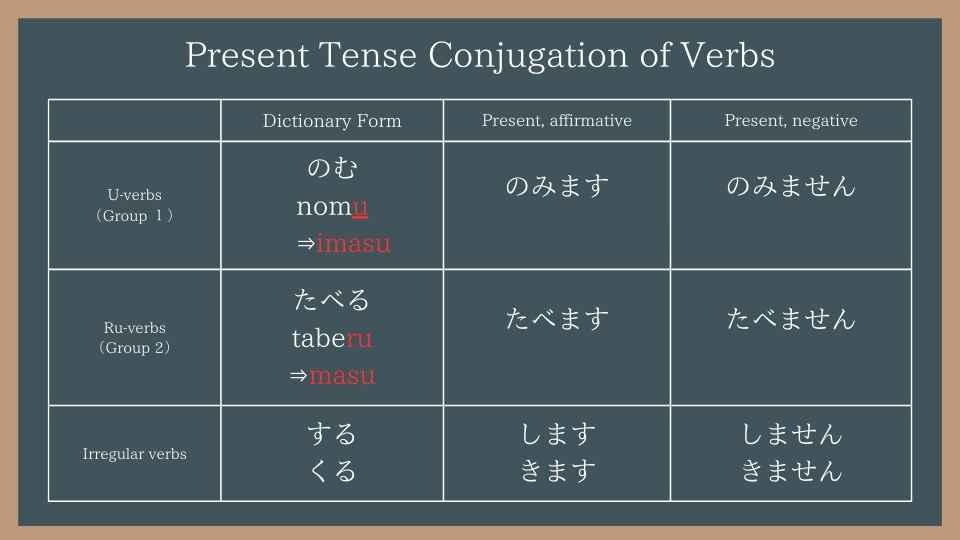
To make the negative, change ます to ません.
Is it a る-verb or an う-verb?
Some verbs end in る but are actually う-verbs. Here is how to check.
- Look at the sound before る. If it is a, u or o (わかる, つくる), the verb is always an う-verb.
- If it is i or e (みる, たべる), it is usually a る-verb, but not always.
- A few common verbs end in -iru or -eru and are still う-verbs. Memorize them.
| Verb | Meaning | Group | ます form |
|---|---|---|---|
| かえるkaeru | to go home | う-verb ⚠ | かえりますkaerimasu |
| はいるhairu | to enter | う-verb ⚠ | はいりますhairimasu |
| はしるhashiru | to run | う-verb ⚠ | はしりますhashirimasu |
| しるshiru | to know | う-verb ⚠ | しりますshirimasu |
| きる (切る)kiru | to cut | う-verb ⚠ | きりますkirimasu |
| きる (着る)kiru | to wear | る-verb | きますkimasu |
| みるmiru | to see | る-verb | みますmimasu |
At this stage, the easiest way is to learn each verb’s group together with its meaning. Use the rule above as a backup check.
Particles: を・で・に・へ
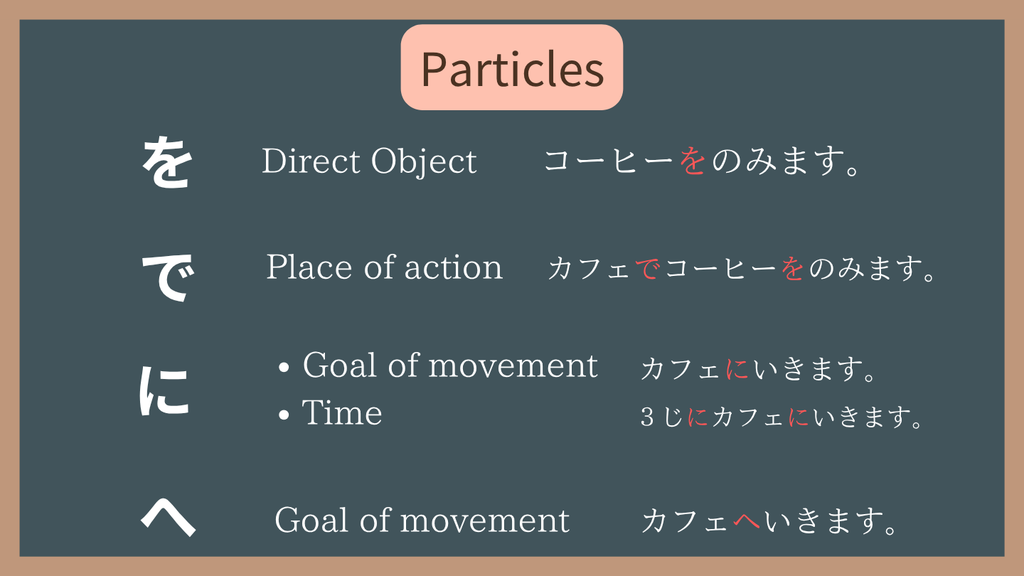
Particles come after a word and show its job in the sentence. Lesson 3 gives you four very important ones.
| Particle | Job | Example |
|---|---|---|
| をo | What the action is done to (direct object) | コーヒーを のみます。koohii o nomimasu. (I drink coffee.) |
| でde | Where the action happens | としょかんで ほんを よみます。toshokan de hon o yomimasu. (I read books at the library.) |
| にni | Where you go (destination) | がっこうに いきます。gakkoo ni ikimasu. (I go to school.) |
| へe | The direction you go | にほんへ いきます。nihon e ikimasu. (I’m going to Japan.) |
- を is read “o,” and へ is read “e” when they are particles.
- に vs で: に is where you go. で is where you do something. としょかんに いきます (I go to the library). としょかんで べんきょうします (I study at the library).
- に vs へ: With いく, くる and かえる, you can use either. に is more common in conversation.
に for time
に also marks the time something happens. Use it with clock times and days of the week.
Don’t use に with words that are relative to “now”: きょう (today), あした (tomorrow), まいにち (every day), いつ (when), こんばん (tonight), あさ (morning). ✗ あしたに → ✓ あした いきます。
Not sure when to use は and when to use が? See は vs が.
Word order and how often
The basic order is topic → time → place → object → verb. The verb always comes last. Because the particles show each word’s job, the order in the middle is flexible.
To say how often you do something, use these adverbs. They usually go after the topic.
| Word | Meaning | Example |
|---|---|---|
| いつもitsumo | always | いつも コーヒーを のみます。itsumo koohii o nomimasu. (I always drink coffee.) |
| よくyoku | often | よく えいがを みます。yoku eiga o mimasu. (I often watch movies.) |
| ときどきtokidoki | sometimes | ときどき ほんを よみます。tokidoki hon o yomimasu. (I sometimes read books.) |
| あまり + ませんamari | not often | あまり テレビを みません。amari terebi o mimasen. (I don’t watch TV much.) |
| ぜんぜん + ませんzenzen | not at all | ぜんぜん おさけを のみません。zenzen osake o nomimasen. (I don’t drink alcohol at all.) |
あまり and ぜんぜん always go with a negative verb (〜ません).
Inviting: 〜ませんか and 〜ましょう
You already know 〜ません (I don’t…). Add か and it becomes a friendly invitation: “Would you like to…?” Use 〜ましょう to say “Let’s…!”
In Japanese, people rarely say a direct “no.” ちょっと… (“it’s a little…”) and a soft voice are enough. The other person will understand.
Final check: 10 questions
These questions mix everything from Lesson 3. Get 8 or more right, and you are ready for Lesson 4.
Free worksheets
Want more practice? Download the printable worksheets for GENKI Lesson 3.
What’s next
- GENKI Lesson 4: あります・います and where things are
- は vs が: a clear explanation for beginners
- GENKI Lesson 2: review これ・それ・あれ
Practice speaking with a real teacher
Now you can talk about your day! Try telling a teacher your routine: しちじに おきます。がっこうに いきます。 On italki, you can find teachers who use GENKI and book a short trial lesson.
This is an affiliate link. If you book a lesson, I may earn a small commission at no extra cost to you.