あります vs います in Japanese + Location Words (GENKI Lesson 4)
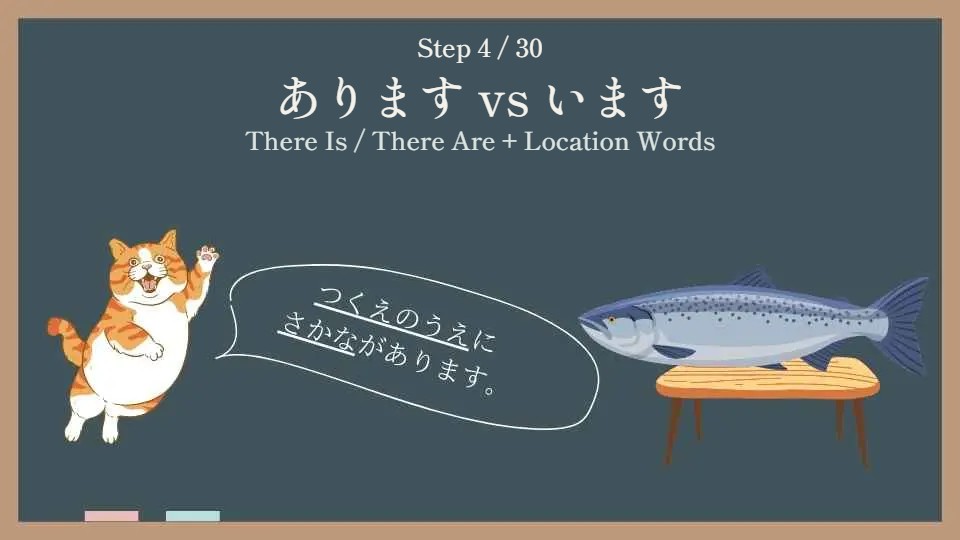
In GENKI Lesson 4, you learn how to say that something or someone is somewhere. You will use this every day: to find a restroom, describe your room, or tell a friend you have a class tomorrow.
This page covers the first half of GENKI Lesson 4. The past tense (でした and ました) is explained in the next lesson.
- あります for things and います for people and animals
- Location words: うえ, した, なか, まえ, うしろ, みぎ, ひだり, となり, ちかく
- Asking どこですか (where is it?)
- Talking about plans and events with あります
Contents
あります and います: “there is”
Japanese has two verbs for “there is” or “to be (somewhere).” Which one you use depends on what you are talking about.
| Verb | Use it for | Example |
|---|---|---|
| ありますarimasu | Things, plants and events (things that don’t move by themselves) | つくえが あります。tsukue ga arimasu. (There is a desk.) |
| いますimasu | People and animals (living things that move) | ねこが います。neko ga imasu. (There is a cat.) |
Ask yourself: “Is it alive, and can it move by itself?” Yes → います. No → あります. A tree is alive, but it doesn’t walk around, so it takes あります.
あります can also mean “to have”: じかんが ありますか (Do you have time?). For people, GENKI uses います: きょうだいが います (I have brothers and sisters).
Where is it? Location words
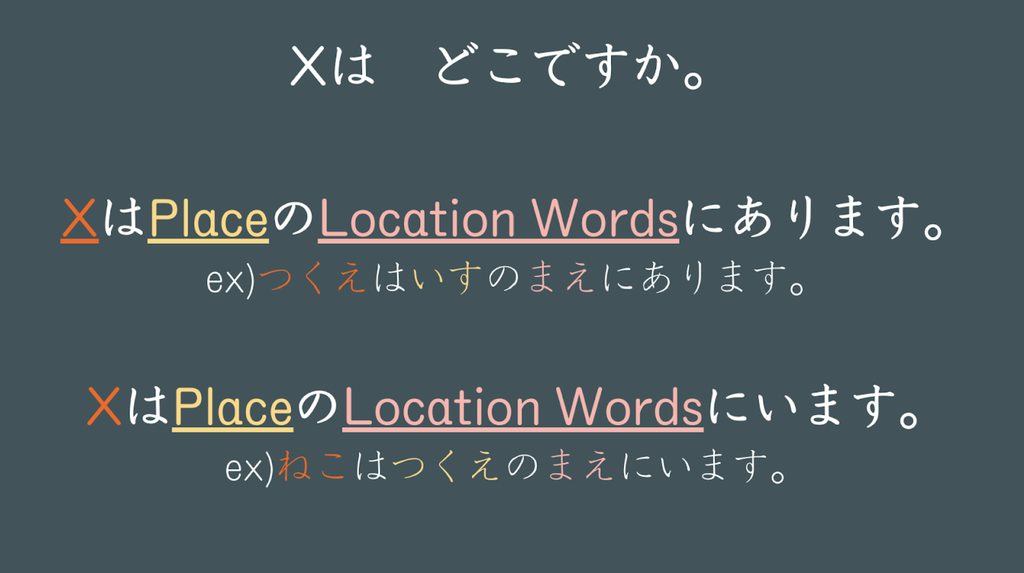
To say where something is, use this pattern. The thing you are talking about is the topic (は), and the place is marked with に.
You can also say it as one simple sentence with です: としょかんは だいがくの まえです。 Both are correct.
Position words
| Word | Meaning | Example |
|---|---|---|
| うえue | on, above | つくえの うえに ほんが あります。tsukue no ue ni hon ga arimasu. (There is a book on the desk.) |
| したshita | under | つくえの したに ねこが います。tsukue no shita ni neko ga imasu. (There is a cat under the desk.) |
| なかnaka | inside | かばんの なかに さいふが あります。kaban no naka ni saifu ga arimasu. (There is a wallet in the bag.) |
| まえmae | in front of | えきの まえに バスていが あります。eki no mae ni basutei ga arimasu. (There is a bus stop in front of the station.) |
| うしろushiro | behind | がっこうの うしろに びょういんが あります。gakkoo no ushiro ni byooin ga arimasu. (There is a hospital behind the school.) |
| みぎmigi | to the right of | ゆうびんきょくの みぎに ぎんこうが あります。yuubinkyoku no migi ni ginkoo ga arimasu. (The bank is to the right of the post office.) |
| ひだりhidari | to the left of | ゆうびんきょくの ひだりに スーパーが あります。yuubinkyoku no hidari ni suupaa ga arimasu. (The supermarket is to the left of the post office.) |
| となりtonari | next to | ゆうびんきょくの となりに ほんやが あります。yuubinkyoku no tonari ni hon’ya ga arimasu. (The bookstore is next to the post office.) |
| ちかくchikaku | near | えきの ちかくに コンビニが あります。eki no chikaku ni konbini ga arimasu. (There is a convenience store near the station.) |
| あいだaida | between | ぎんこうと ほんやの あいだginkoo to hon’ya no aida (between the bank and the bookstore) |
In English you say “on the desk,” but in Japanese the order is “the desk’s top”: つくえの うえ. Always put の between the thing and the position word.
Asking “where?”: どこですか
Talking about plans with あります
あります is also used for events: a class, a test, a party, a meeting. This is how you say “I have (a plan).”
Days of the week take に (げつようびに). Words like あした and しゅうまつ don’t need に. You learned this in Lesson 3.
Final check: 8 questions
These questions mix everything on this page. Get 7 or more right, and you are ready for the past tense.
Free worksheet
Want to practice writing? Download the printable worksheet for this lesson.
What’s next
- GENKI Lesson 4, part 2: the past tense with でした and ました
- GENKI Lesson 3: review verbs and particles
- Essential Japanese Phrases for Travel: asking for directions
Practice speaking with a real teacher
Describe your room to a teacher: つくえの うえに パソコンが あります。ベッドの したに ねこが います。 On italki, you can find teachers who use GENKI and book a short trial lesson.
This is an affiliate link. If you book a lesson, I may earn a small commission at no extra cost to you.