Everyday Japanese: もう/まだ, つもり, 〜てみる, 〜ておく
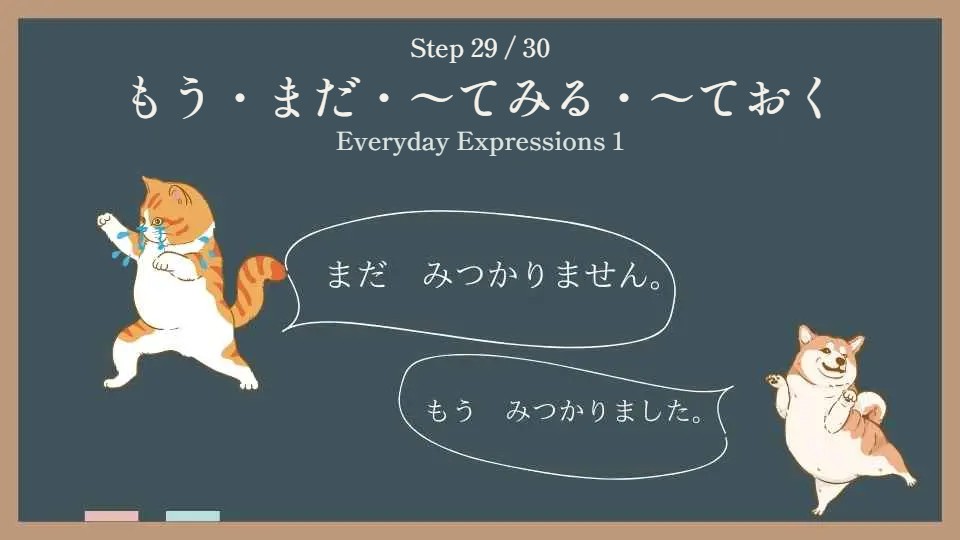
Some short expressions make a huge difference in how natural your Japanese sounds. In this lesson, you will learn five of them, each with real conversation examples. They come from GENKI Lessons 9, 10, 13 and 15.
- もう and まだ: already, not yet, still
- 〜つもりです: I plan to …
- どこかに and どこにも: somewhere, nowhere
- 〜てみる: try doing
- 〜ておく: do something in advance
Contents
もう and まだ
| Word | With affirmative | With negative |
|---|---|---|
| もうもう | already: もう食べましたもう たべました (I already ate.) | not … anymore: もうお金がないもう おかねが ない (I have no money left.) |
| まだまだ | still: まだ雨が降っているまだ あめが ふっている (It’s still raining.) | not yet: まだ食べていませんまだ たべていません (I haven’t eaten yet.) |
“Not yet” is まだです or まだ〜ていません. ✗ まだ食べませんでした.
〜つもりです: I plan to …
Put a verb in the dictionary form or ない form before つもりです to talk about a plan you have decided on.
つもり sounds like a firmer decision. 〜ようと思っています is softer: you are thinking about it. Also, don’t ask a superior 〜つもりですか. It can sound rude.
どこかに and どこにも
| Expression | Meaning | Example |
|---|---|---|
| どこか(に)どこか(に) | somewhere | 週末、どこかに行きたいな。しゅうまつ、どこかに いきたいな。 (I want to go somewhere this weekend.) |
| どこにも + negativeどこにも | nowhere, not anywhere | 今日はどこにも行かない。きょうは どこにも いかない。 (I’m not going anywhere today.) |
The same pattern works with other question words: 何か (something) / 何も (nothing), だれか (someone) / だれも (no one).
〜てみる: try doing
Use the te-form + みる to say you try something to see what it’s like.
〜ておく: do something in advance
The te-form + おく means you do something beforehand, to be ready, or you leave something as it is.
In conversation, 〜ておく often becomes 〜とく: 予約しとく (I’ll book it), 開けといて (leave it open).
Final check: 10 questions
Get 8 or more right, and these expressions are yours!
What’s next
- More Everyday Expressions: 〜てしまう, のように, はず and more
- The volitional form: 〜ようと思っています
- Essential Japanese Phrases for Travel
Practice speaking with a real teacher
These expressions are best learned in real conversation. Ask a teacher about their plans: 週末はどこかに行くつもりですか。 On italki, you can find teachers who use GENKI and book a short trial lesson.
This is an affiliate link. If you book a lesson, I may earn a small commission at no extra cost to you.