Japanese Volitional Form and 〜ようと思っています (GENKI Lesson 15)
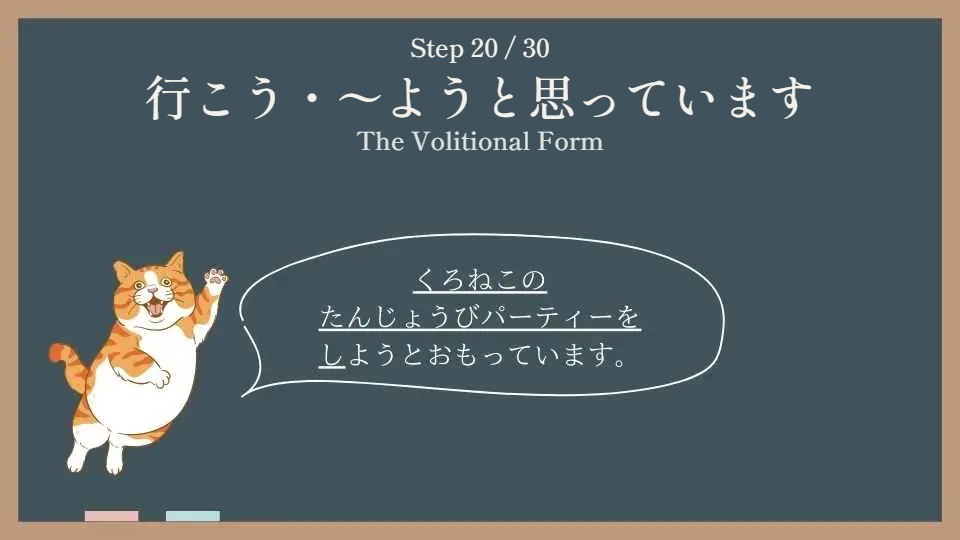
The volitional form is the casual version of 〜ましょう. 行こう! means “Let’s go!” With と思っています, it lets you talk about your plans: “I’m thinking of studying in Japan.” You learn it in GENKI Lesson 15.
- How to make the volitional form
- Casual “let’s …” and “shall we …?”
- 〜ようと思っています: I’m thinking of doing …
Contents
How to make the volitional form
| Verb group | Rule | Example |
|---|---|---|
| う-verbs | last sound → お sound + う | 行く → 行こう、飲む → 飲もう、話す → 話そういこう、のもう、はなそう |
| る-verbs | drop る + よう | 食べる → 食べよう、見る → 見ようたべよう、みよう |
| する | する → しようしよう | |
| 来る | 来る → 来ようこよう |
The volitional form is the casual version of 〜ましょう: 行きましょう → 行こう, 食べましょう → 食べよう.
Use 1: Let’s … (casual)
Use it with friends and family to suggest doing something together.
Shall we …? / Shall I …?: 〜ようか
Add か to make a casual suggestion or offer. It is the casual version of 〜ましょうか.
Use 2: Talking to yourself
The volitional form is also what you say to yourself when you decide something.
Use 3: 〜ようと思っています: I’m thinking of …
Add と思っています (or と思う) to talk about plans and intentions. It means the idea is in your head now, but it may not be final.
〜ようと思います: you decided just now. 〜ようと思っています: you have had this plan for a while. For other people, only 〜ようと思っています works: 兄は車を買おうと思っています.
For a firmer plan, you can also use 〜つもりです.
Final check: 10 questions
These questions mix everything on this page. Get 8 or more right, and you’ve got it!
What’s next
- そうです, ようです and みたいです: guessing and hearsay
- Everyday Expressions: 〜つもりだ, 〜てみる and 〜ておく
- GENKI Lesson 3: review 〜ましょう and 〜ませんか
Practice speaking with a real teacher
Talk about your plans with a teacher: 来年、日本に旅行しようと思っています。 On italki, you can find teachers who use GENKI and book a short trial lesson.
This is an affiliate link. If you book a lesson, I may earn a small commission at no extra cost to you.