Japanese そうです vs ようです vs みたいです: The Clear Difference
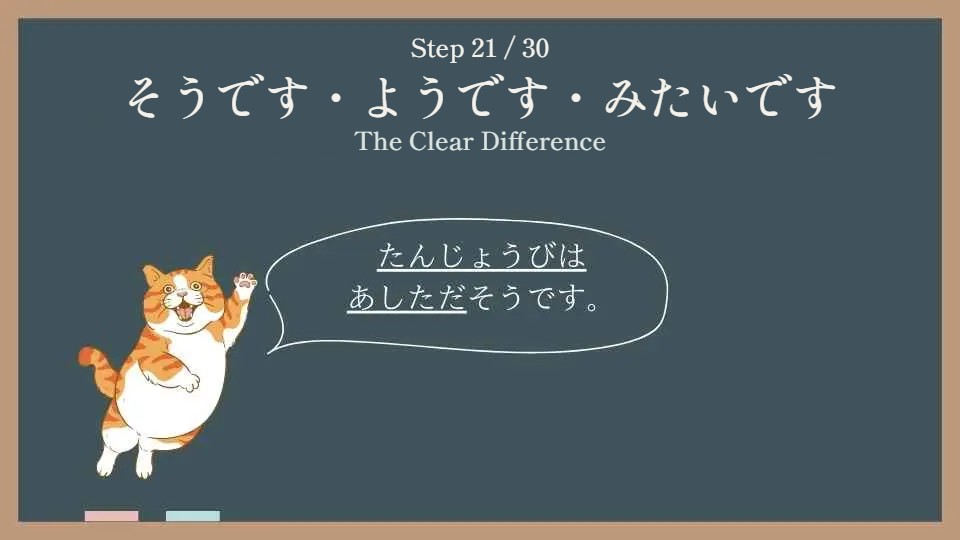
そうです, ようです and みたいです can all be translated as “it seems.” The difference is where your information comes from: what you see with your own eyes, what someone told you, or what you guess from clues. This lesson shows you how to choose, and how to connect each one correctly.
- そうです ①: looks like (from what you see)
- そうです ②: I heard that (hearsay)
- ようです and みたいです: it seems (from clues)
Contents
Quick overview
| Expression | Based on | Example |
|---|---|---|
| そうです ① (looks) | What you see right now | おいしそうです。おいしそうです。 (It looks delicious.) |
| そうです ② (hearsay) | What someone told you | おいしいそうです。おいしいそうです。 (I heard it’s delicious.) |
| ようです | Clues and your judgment (a bit formal) | だれもいないようです。だれも いない ようです。 (It seems no one is here.) |
| みたいです | Same as ようです, but casual | だれもいないみたいです。だれも いない みたいです。 |
おいしそう (looks delicious) and おいしいそう (I heard it’s delicious) differ by just one い. The connection tells you which そうです it is.
そうです ①: looks like
Use it when you see something and describe your impression, before you know for sure. GENKI Lesson 13.
| Type | Connection | Example |
|---|---|---|
| い-adjective | drop い + そう | おいしそうおいしそう (looks delicious) |
| な-adjective | drop な + そう | 元気そうげんきそう (looks well) |
| verb | ます stem + そう | 雨が降りそうあめが ふりそう (looks like it will rain) |
| いい | → よさそう | よさそうよさそう (looks good) |
| ない | → なさそう | おもしろくなさそうおもしろくなさそう (doesn’t look interesting) |
Don’t use this そう with nouns (✗ 学生そう), and don’t use it for things you can clearly see: ✗ きれいそう for a flower right in front of you. Just say きれいですね.
そうです ②: I heard that …
Use it to pass on information from someone else, the news or a website. Put the short form before そうです. GENKI Lesson 17.
| Type | Connection | Example |
|---|---|---|
| verb | short form + そう | 来るそうですくる そうです (I heard he’s coming) |
| い-adjective | short form + そう | おいしいそうですおいしい そうです |
| な-adjective | + だ + そう | 元気だそうですげんきだ そうです |
| noun | + だ + そう | 学生だそうですがくせいだ そうです |
〜によると (according to …) often comes with hearsay そうです. In casual speech, people often use 〜って instead: 明日、雨だって (I heard it will rain tomorrow).
ようです and みたいです: it seems
Use these when you guess from clues: a sound, a situation, something you noticed. ようです is a little formal. みたいです is casual and very common in conversation.
| Type | ようです | みたいです |
|---|---|---|
| verb | 降っているようですふっている ようです | 降っているみたいですふっている みたいです |
| い-adjective | 寒いようですさむい ようです | 寒いみたいですさむい みたいです |
| な-adjective | 静かなようですしずかな ようです | 静かみたいですしずか みたいです |
| noun | 学生のようですがくせいの ようです | 学生みたいですがくせい みたいです |
ようです and みたいです can also mean “like” (similar to): 夢のようです / 夢みたいです (It’s like a dream). See のように / のような.
Final check: 10 questions
These questions mix all three expressions. Get 8 or more right, and you have mastered one of the trickiest parts of Japanese!
What’s next
- 〜たら: the most useful “if” in Japanese
- かもしれない, でしょう, はず: how sure are you?
- More Everyday Expressions: のように and のような
Practice speaking with a real teacher
These three are hard to choose in real time. Practice by describing photos to a teacher: このラーメン、おいしそうですね。 On italki, you can find teachers who use GENKI and book a short trial lesson.
This is an affiliate link. If you book a lesson, I may earn a small commission at no extra cost to you.