Japanese かもしれない, でしょう, はず, に違いない: How Sure Are You?
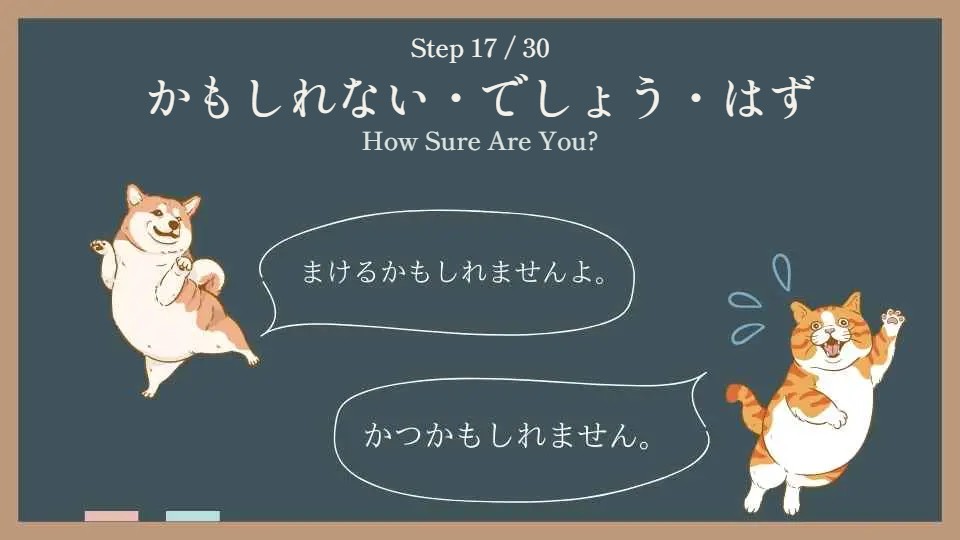
English uses “might,” “probably” and “must” to show how sure you are. Japanese has its own set of endings for this. In this lesson, you will learn four of them, from the least sure to the most sure, and how to connect each one to verbs, adjectives and nouns.
かもしれません appears in GENKI Lesson 14, でしょう in GENKI Lesson 12, and はず in GENKI Lesson 19. に違いない is a JLPT N3 expression.
- 〜かもしれません: might, maybe
- 〜だろう / 〜でしょう: probably
- 〜はずです: should be (based on a reason)
- 〜に違いない: must be (no doubt)
Contents
The certainty scale
| How sure? | Expression | English |
|---|---|---|
| about 30% | かもしれないかもしれない | might, maybe |
| about 70% | だろう / でしょうだろう / でしょう | probably, I suppose |
| about 90% | はずだはずだ | should be, is supposed to be |
| almost 100% | に違いないに ちがいない | must be, no doubt |
The percentages are only a guide, but they help you choose. Now let’s look at each one.
かもしれません: might
Use it when something is possible, but you are not sure. It is also a polite way to soften what you say.
| Type | Connection | Example |
|---|---|---|
| verb | short form + かもしれない | 行くかもしれないいく かもしれない (might go) |
| い-adjective | short form + かもしれない | 高いかもしれないたかい かもしれない (might be expensive) |
| な-adjective | no だ + かもしれない | 静かかもしれないしずか かもしれない (might be quiet) |
| noun | no だ + かもしれない | 学生かもしれないがくせい かもしれない (might be a student) |
だろう / でしょう: probably
Use it when you think something is likely. でしょう is the polite form. You often hear it in weather forecasts. The connection is the same as かもしれない: no だ after な-adjectives and nouns.
With a rising voice, でしょう? asks for agreement: “…, right?” 明日、来るでしょう? (You’re coming tomorrow, right?)
はずです: should be
Use はず when you have a reason to expect something: a schedule, a fact, or logic.
| Type | Connection | Example |
|---|---|---|
| verb | short form + はず | 来るはずくる はず |
| い-adjective | short form + はず | 高いはずたかい はず |
| な-adjective | + な + はず | 静かなはずしずかな はず |
| noun | + の + はず | 休みのはずやすみの はず |
はずがない means “there’s no way …”: 彼がそんなことを言うはずがない (There’s no way he would say that).
に違いない: must be
The strongest one. Use it when you are almost certain. It sounds a little formal or dramatic, and it is common in writing, novels and detective stories. The connection is the same as かもしれない.
Final check: 8 questions
Choose the expression that fits each situation. Get 7 or more right, and you have it!
What’s next
- あげる, くれる and もらう: giving and receiving
- そうです, ようです and みたいです: more ways to guess
- More Everyday Expressions: はず and more
Practice speaking with a real teacher
Guessing expressions sound natural only with practice. Ask a teacher about tomorrow’s weather and answer with かもしれません and でしょう. On italki, you can find teachers who use GENKI and book a short trial lesson.
This is an affiliate link. If you book a lesson, I may earn a small commission at no extra cost to you.