Japanese 〜たい vs ほしい: How to Say What You Want (GENKI Lessons 11, 14)
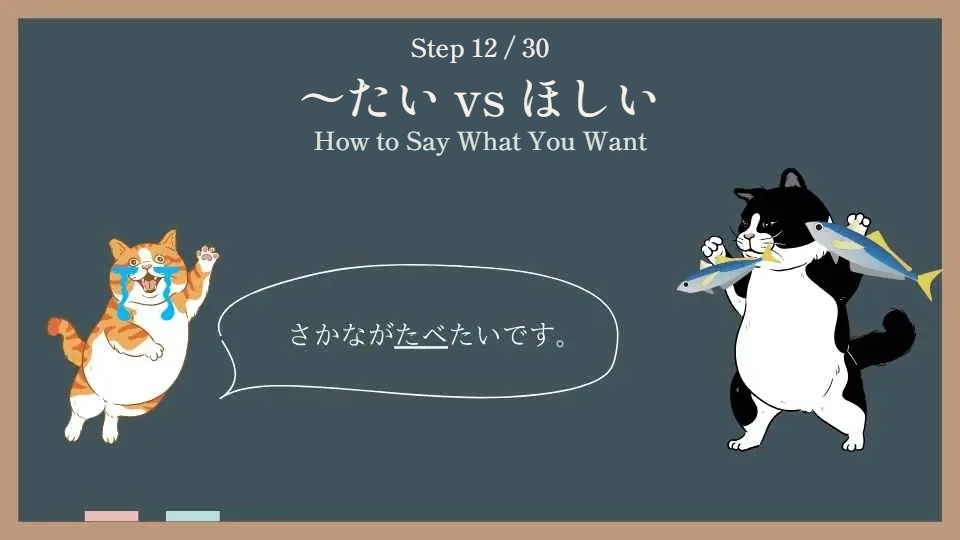
Japanese has two ways to say “want.” Use 〜たい when you want to do something, and ほしい when you want a thing. You also need a different form when you talk about what someone else wants. This lesson covers 〜たい from GENKI Lesson 11 and ほしい from GENKI Lesson 14.
- 〜たい: I want to do …
- ほしい: I want (a thing)
- Other people’s wishes: 〜たがっている and 〜たいと言っていました
Contents
〜たい: I want to do …
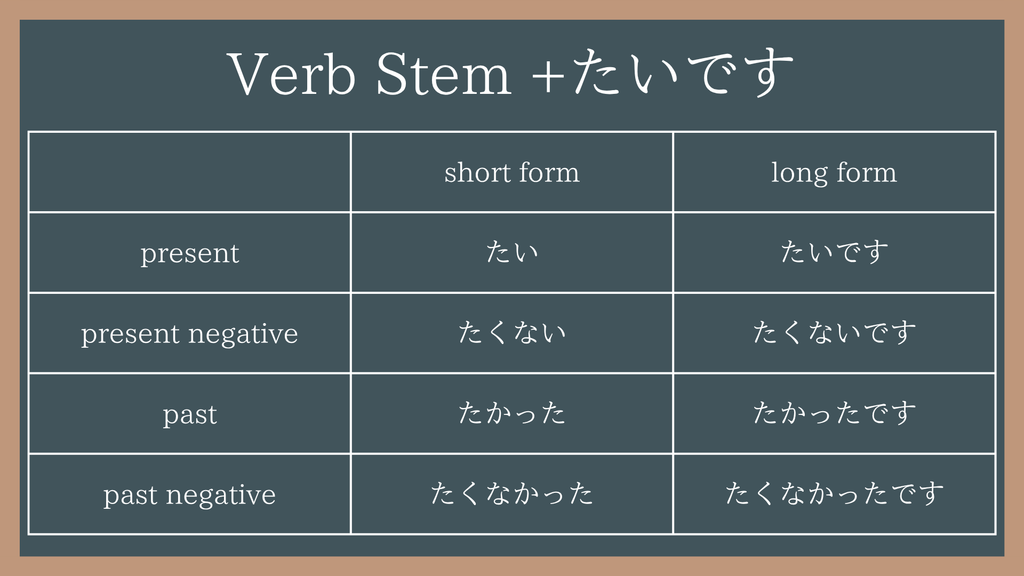
Take the ます form, drop ます, and add たい. The result works like an い-adjective.
| ます form | たい form | Meaning |
|---|---|---|
| 食べますたべます | 食べたいたべたい | want to eat |
| 行きますいきます | 行きたいいきたい | want to go |
| しますします | したいしたい | want to do |
| Form | Example | Meaning |
|---|---|---|
| present | 行きたいですいきたいです | I want to go |
| negative | 行きたくないですいきたくないです | I don’t want to go |
| past | 行きたかったですいきたかったです | I wanted to go |
| past negative | 行きたくなかったですいきたくなかったです | I didn’t want to go |
With 〜たい, you can mark the object with を or が: ラーメンを食べたい / ラーメンが食べたい. Both are correct. Other particles like に and で don’t change.
ほしい: I want (a thing)
When you want a thing, use ほしい. It is an い-adjective, and the thing you want takes が.
To want a thing → ほしい. To want to do → 〜たい. ✗ 車がほしいたいです → ✓ 車がほしいです / 車を買いたいです.
What other people want
In Japanese, you can’t say for sure what is inside someone else’s head. So 〜たい and ほしい are used only for yourself (and in questions to the listener). For other people, use one of these.
〜たがっている / ほしがっている: seems to want
Drop い from たい or ほしい and add がっている. It means you can see they want it from how they act.
With 〜たがっている and ほしがっている, the object always takes を, not が.
〜たいと言っていました: said they want
A very common and natural way: report what the person said.
Final check: 10 questions
These questions mix everything on this page. Get 8 or more right, and you are ready for the next lesson.
Free worksheet
Want to practice writing? Download the printable worksheet for this lesson.
What’s next
- GENKI Lesson 11: 〜たことがある, 〜たり〜たり and や
- GENKI Lesson 10: review comparisons
- Essential Japanese Phrases for Travel
Practice speaking with a real teacher
Talk about your dreams with a teacher: 日本に行ったら、富士山に登りたいです。 On italki, you can find teachers who use GENKI and book a short trial lesson.
This is an affiliate link. If you book a lesson, I may earn a small commission at no extra cost to you.