How to Compare in Japanese: より, ほうが and いちばん (GENKI Lesson 10)
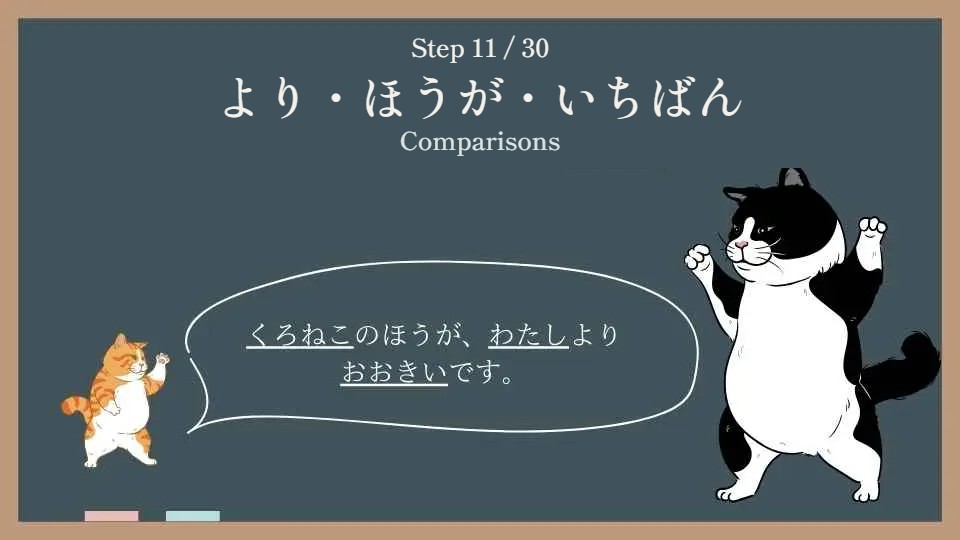
Japanese has no “-er” or “-est” endings. Instead, you use a few small words to compare things: より (than), のほうが (the one that is more) and いちばん (the most). In this GENKI Lesson 10 guide, you will learn to compare two things, three or more things, and to talk about change with なる.
- Comparing two things: AのほうがBより…
- Asking “which one?”: AとBとどちらが…
- The most: …の中で Aがいちばん…
- Talking about change: adjective + なる
Contents
Comparing two things

A のほうが marks the winner (“A is more …”). B より means “than B.” You can also swap the order: B より A のほうが ….
Asking which one: どちら
どちら is polite. どっち is casual. Both mean “which one (of two).”
The same: 同じぐらい
Three or more: いちばん

の中で sets the group (“among …”). いちばん means “number one,” so “the most.”
Choose the question word that fits the answer: だれ for people, 何 for things, どこ for places, いつ for times. All of them take が.
Talking about change: adjective + なる
なる means “to become.” GENKI Lesson 10 uses it with adjectives and nouns.
| Type | Rule | Example |
|---|---|---|
| い-adjective | い → くなる | 寒くなりましたさむく なりました (It got cold.) |
| な-adjective | + になる | 上手になりましたじょうずに なりました (I got better at it.) |
| noun | + になる | 先生になりたいですせんせいに なりたいです (I want to become a teacher.) |
You will learn more GENKI Lesson 10 expressions, like 〜つもりです and どこかに, in Everyday Expressions.
Final check: 10 questions
These questions mix everything on this page. Get 8 or more right, and you are ready for GENKI Lesson 11.
Free worksheet
Want to practice writing? Download the printable worksheet for GENKI Lesson 10.
What’s next
- GENKI Lesson 11: saying what you want with 〜たい and ほしい
- GENKI Lesson 5: review い- and な-adjectives
- Everyday Expressions: つもり, どこかに and more
Practice speaking with a real teacher
Comparisons are great for conversation. Ask a teacher: 日本の季節の中で、いつがいちばん好きですか。 On italki, you can find teachers who use GENKI and book a short trial lesson.
This is an affiliate link. If you book a lesson, I may earn a small commission at no extra cost to you.